
Empires come and goes but they rarely fade quietly. When the Maurya Empire collapsed around 185 BCE, it did not leave behind an empty map. The things that followed were something far more interesting. There was a long stretch of time when dozens of kingdoms competed, clashed, traded, and borrowed from each other. Foreign rulers arrived and, over time, became Indian. Artists blended styles from two different worlds. Poets in the South gave an entire age its name. This chapter covers all of that.
Chapter 6, titled The Age of Reorganisation, is part of the unit Tapestry of the Past from the Class 7 NCERT textbook Exploring Society: India and Beyond (Part 1). It covers the period from around 185 BCE to the 3rd century CE, a time when India’s political map was constantly shifting.
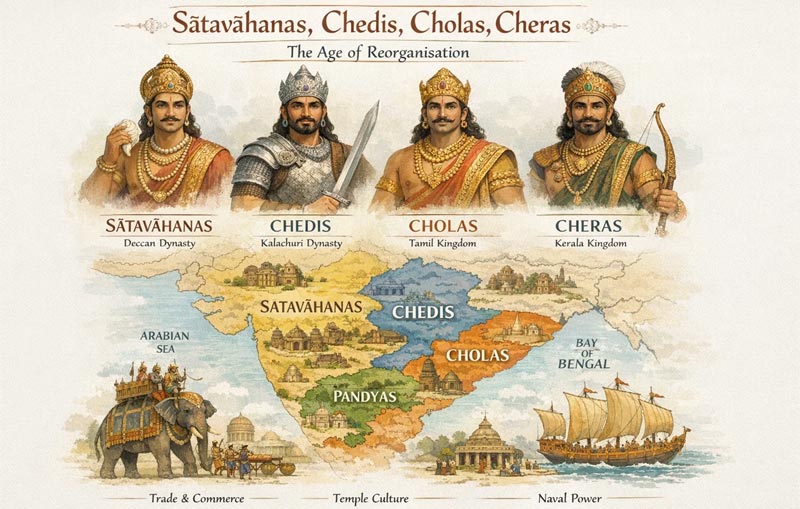
Here is a quick look at what The Age of Reorganisation chapter 6 of NCERT book covers:
- Why ‘Age of Reorganisation’: Former Mauryan tributary kingdoms broke free and new powers emerged across the subcontinent.
- End of the Maurya Empire (around 185 BCE): The last Maurya emperor was killed by his own commander-in-chief, Pushyamitra Shunga.
- The Shunga dynasty: Ruled north and central India, revived Vedic practices, and patronised art at the Bharhut Stupa.
- Patanjali’s Yoga Sutras: These were compiled during the Shunga period in Sanskrit. This is a foundational text on yoga and is very relevant even in the moder times.
- The Satavahanas (2nd century BCE onward): They ruled the Deccan region that covers present-day Andhra Pradesh, Telangana, and Maharashtra.
- Maritime trade under the Satavahanas: The coins during this times depict ships. Trade reached the Roman Empire during this period. This period is known for the export of spices, textiles, and ivory.
- Numerals and inscriptions: Naneghat cave inscriptions in Brahmi script show early numeral forms, evidence that modern numerals originated in India.
- The Chedi dynasty and Kharavela: Kalinga rose again under the Chedis. Kharavela’s Hathigumpha inscription records his campaigns and welfare works.
- Udayagiri-Khandagiri caves: Rock-cut caves near Bhubaneswar. It was built for Jain monks. It is known for its intricate carvings and precise craftsmanship.
- Southern kingdoms – Cholas, Cheras, Pandyas: Three powerful south Indian kingdoms, independent even at the height of Mauryan power.
- Sangam literature: The oldest Tamil poetry, covering love, heroism, and generosity. It defines the entire Sangam Age.
- Silappadikaram: A Tamil epic about Kannagi and Kovalan, built around justice and dharma. Kannagi is still worshipped today.
- Kallani or Grand Anicut: A Kaveri river diversion system built by Chola king Karikala, still in use today.
- The Indo-Greeks: Descendants of Alexander’s satraps who ruled the northwest and gradually absorbed Indian culture and beliefs.
- The Shakas (Indo-Scythians): Ruled from the 2nd century BCE to 5th century CE. Their Shaka Samvat calendar became India’s National Calendar in 1957.
- The Kushanas (around 2nd century CE): Central Asian rulers whose empire stretched from central Asia to northern India.
- Gandhara school of art: Blended Greco-Roman and Indian styles using grey-black schist stone, known for realistic Buddha images.
- Mathura school of art: Distinctly Indian style using red sandstone, depicting Hindu and Buddhist deities with fuller, smoother figures.
- The Silk Route: A vast trade network linking India, central Asia, China, and the Mediterranean, largely controlled by the Kushanas.
This chapter shows that, even in modern times, India was never just one thing at any given time. Kingdoms fought in the north, poets were redefining literature in the south during this period. Foreign rulers brought their own gods and art, and in the process adopted Indian ones. That back-and-forth, that constant absorption and reinvention, is what makes this period so important for understanding how Indian civilisation actually grew.
Try these MCQ questions for Class 7 Social Science to check how well you have understood this chapter.
Class 7 The Age of Reorganisation MCQ Questions with Answers
Class 7 SST Chapter 6 The Age of Reorganisation MCQ Questions
1. Why is the post-Maurya period often called the “Age of Reorganisation”?
a) Because the Maurya Empire expanded further
b) Because old regions were reorganised into many competing kingdoms
c) Because all kingdoms united permanently
d) Because foreign rulers were completely absent
Answer:
b) Because old regions were reorganised into many competing kingdoms
2. The last Maurya emperor is generally believed to have been assassinated around
a) 321 BCE
b) 273 BCE
c) 185 BCE
d) 78 CE
Answer:
c) 185 BCE
3. Who founded the Shunga dynasty?
a) Kharavela
b) Pushyamitra Shunga
c) Gautamīputra Satakarni
d) Kanishka
Answer:
b) Pushyamitra Shunga
4. Pushyamitra Shunga performed which Vedic ritual to establish himself as a powerful ruler?
a) Rajasuya yajna
b) Agnihotra
c) Ashvamedha yajna
d) Putrakameshti yajna
Answer:
c) Ashvamedha yajna
5. During the Shunga period, which language emerged as a preferred medium for philosophical and literary works?
a) Prakrit
b) Tamil
c) Pali
d) Sanskrit
Answer:
d) Sanskrit
6. The Yoga Sutras were compiled during this period by
a) Patanjali
b) Kauṭilya
c) Megasthenes
d) Kalidasa
Answer:
a) Patanjali
7. The Bharhut Stupa is especially important because the Shungas added
a) giant gateways of marble only
b) beautifully carved railings and reliefs
c) tall iron pillars
d) a palace around it
Answer:
b) beautifully carved railings and reliefs
8. The Satavahanas are sometimes also referred to as the
a) Yavanas
b) Andhras
c) Keralaputras
d) Shakas
Answer:
b) Andhras
9. Which pair of cities is mentioned as famous capitals of the Satavahanas at different times?
a) Madurai and Vanji
b) Ujjain and Taxila
c) Amravatī and Pratiṣhṭhana
d) Paṭaliputra and Vidisha
Answer:
c) Amravatī and Pratiṣhṭhana
10. Coins of the Satavahanas often depicted ships mainly because
a) they fought only naval wars
b) maritime trade was important to their economy
c) they had no roads on land
d) they ruled only islands
Answer:
b) maritime trade was important to their economy
11. Which river system is mentioned as supporting agriculture under the Satavahanas?
a) Indus-Sutlej
b) Narmada-Tapi
c) Krishna-Godavari
d) Mahanadi-Brahmani
Answer:
c) Krishna-Godavari
12. Gautamīputra Satakarni’s title is significant because it shows that princes were often named after their
a) fathers
b) teachers
c) mothers
d) ministers
Answer:
c) mothers
13. Kharavela, an important ruler of the Chedi dynasty, is described as a devoted follower of
a) Buddhism
b) Jain teachings
c) Vedic sacrifice alone
d) Greek religion
Answer:
b) Jain teachings
14. The Udayagiri-Khandagiri caves near Bhubaneswar are notable examples of
a) brick temple architecture
b) underground cities
c) rock-cut architecture
d) wooden palace construction
Answer:
c) rock-cut architecture
15. The literary collections of south India belonging to this era are collectively called
a) Vedic literature
b) Sangam literature
c) court chronicles
d) Jataka tales
Answer:
b) Sangam literature
16. Which Chola king is said to have defeated a combined force of the Cheras and Panḍyas?
a) Karikala
b) Kharavela
c) Kanishka
d) Pushyamitra Shunga
Answer:
a) Karikala
17. The Kallanai or Grand Anicut was built to
a) stop all river trade
b) divert Kaveri waters for irrigation
c) serve as a military fort
d) mark the boundary of the Chola kingdom
Answer:
b) divert Kaveri waters for irrigation
18. The Cheras were especially known for trade with
a) China and Japan only
b) the Roman Empire and West Asia
c) Egypt alone
d) the Mauryas only
Answer:
b) the Roman Empire and West Asia
19. The Heliodorus pillar near Vidisha is important because it reflects
a) only Mauryan military power
b) links between Indo-Greeks and Indian religious traditions
c) the decline of sculpture
d) the invention of Brahmi script
Answer:
b) links between Indo-Greeks and Indian religious traditions
20. The Shaka Samvat calendar begins from
a) 321 BCE
b) 185 BCE
c) 78 CE
d) 1957 CE
Answer:
c) 78 CE
21. Which statement correctly distinguishes the Gandhara and Mathura schools of art?
a) Gandhara used red sandstone and Mathura used grey-black schist
b) Gandhara showed Greco-Roman influence, while Mathura had a stronger Indian style
c) Both schools avoided making images of deities
d) Mathura art developed outside India
Answer:
b) Gandhara showed Greco-Roman influence, while Mathura had a stronger Indian style
The Age of Reorganisation Class 7 Assertion-Reason Questions
1. Assertion (A): The post-Maurya period is called the Age of Reorganisation. Reason (R): After the fall of the Mauryas, many new kingdoms emerged and competed for power across the subcontinent.
a) Both A and R are true, and R is the correct explanation of A
b) Both A and R are true, but R is not the correct explanation of A
c) A is true, but R is false
d) A is false, but R is true
Answer:
a) Both A and R are true, and R is the correct explanation of A
2. Assertion (A): Satavahana coins often showed ships. Reason (R): Maritime trade formed an important part of Satavahana economic life.
a) Both A and R are true, and R is the correct explanation of A
b) Both A and R are true, but R is not the correct explanation of A
c) A is true, but R is false
d) A is false, but R is true
Answer:
a) Both A and R are true, and R is the correct explanation of A
3. Assertion (A): Kharavela is remembered as a ruler with broad-minded values. Reason (R): His inscription presents him as respectful of every sect and concerned for the welfare of his people.
a) Both A and R are true, and R is the correct explanation of A
b) Both A and R are true, but R is not the correct explanation of A
c) A is true, but R is false
d) A is false, but R is true
Answer:
a) Both A and R are true, and R is the correct explanation of A
4. Assertion (A): The Kushana period saw extensive cultural intermixing. Reason (R): The Kushanas controlled important trade routes and encouraged art that blended Indian and Greek features.
a) Both A and R are true, and R is the correct explanation of A
b) Both A and R are true, but R is not the correct explanation of A
c) A is true, but R is false
d) A is false, but R is true
Answer:
a) Both A and R are true, and R is the correct explanation of A
5. Assertion (A): The Mathura school of art is different from the Gandhara school. Reason (R): Mathura art used red sandstone and reflected a more distinct Indian style with less Greco-Roman influence.
a) Both A and R are true, and R is the correct explanation of A
b) Both A and R are true, but R is not the correct explanation of A
c) A is true, but R is false
d) A is false, but R is true
Answer:
a) Both A and R are true, and R is the correct explanation of A
The Age of Reorganisation Class 7 Fill in the blanks Questions
1. The commander-in-chief who founded the Shunga dynasty was __________ Shunga.
Answer:
Pushyamitra
2. The Vedic ritual used by several rulers to declare supremacy was the __________ yajna.
Answer:
ashvamedha
3. The Bharhut Stupa is located in present-day __________ Pradesh.
Answer:
Madhya
4. The Satavahanas had important trade links with the __________ Empire.
Answer:
Roman
5. Gautamī Balashrī was the mother of Gautamīputra __________.
Answer:
Satakarni
6. The famous Udayagiri-Khandagiri caves are located near __________.
Answer:
Bhubaneswar
7. The oldest literary tradition of south India discussed in the chapter is called __________ literature.
Answer:
Sangam
8. The Kallanai is built across the river __________.
Answer:
Kaveri
9. The Shakas are also sometimes called Indo-__________.
Answer:
Scythians
10. The Gandhara school commonly used grey-black __________ stone.
Answer:
schist
The Age of Reorganisation Class 7 True or False Questions
1. The Maurya Empire remained strong for many centuries after Ashoka.
Answer:
False
2. The Shungas revived Vedic rituals, but other schools of thought also continued to flourish.
Answer:
True
3. Satavahana trade was limited only to inland areas.
Answer:
False
4. The Naneghat caves were linked with trade routes and collection of tolls and taxes.
Answer:
True
5. Kharavela’s Hathīgumpha inscription is written in Brahmi script.
Answer:
True
6. Sangam literature is the oldest literary tradition of north India.
Answer:
False
7. The Cheras were also known as Keralaputra.
Answer:
True
8. The Indo-Greeks remained completely untouched by Indian culture.
Answer:
False
9. The Shaka Samvat was adopted as the Indian National Calendar in 1957.
Answer:
True
10. Mathura art generally shows less Greco-Roman influence than Gandhara art.
Answer:
True
The Age of Reorganisation Class 7 Match the following Questions
Question 1
| Column A | Column B |
|---|---|
| 1. Pushyamitra Shunga | A. Udayagiri-Khandagiri caves |
| 2. Satavahanas | B. Founder of the Shunga dynasty |
| 3. Kharavela | C. Maritime trade and ship coins |
| 4. Karikala | D. Kallanai or Grand Anicut |
| 5. Heliodorus pillar | E. Indo-Greek connection with Vasudeva |
Answer:
| Column A | Correct Answer |
|---|---|
| 1. Pushyamitra Shunga | B. Founder of the Shunga dynasty |
| 2. Satavahanas | C. Maritime trade and ship coins |
| 3. Kharavela | A. Udayagiri-Khandagiri caves |
| 4. Karikala | D. Kallanai or Grand Anicut |
| 5. Heliodorus pillar | E. Indo-Greek connection with Vasudeva |
Question 2
| Column A | Column B |
|---|---|
| 1. Gandhara school | A. Red sandstone and stronger Indian style |
| 2. Mathura school | B. Adopted as Indian National Calendar in 1957 |
| 3. Shaka Samvat | C. Grey-black schist and Greco-Roman influence |
| 4. Sangam Age | D. Associated with assemblies of poets |
| 5. Kushanas | E. Controlled important parts of the Silk Route |
Answer:
| Column A | Correct Answer |
|---|---|
| 1. Gandhara school | C. Grey-black schist and Greco-Roman influence |
| 2. Mathura school | A. Red sandstone and stronger Indian style |
| 3. Shaka Samvat | B. Adopted as Indian National Calendar in 1957 |
| 4. Sangam Age | D. Associated with assemblies of poets |
| 5. Kushanas | E. Controlled important parts of the Silk Route |
Related Class 7 History Chapters
Follow India’s past in order through these history chapters:
- New Beginnings: Cities and States MCQs
- The Rise of Empires MCQs
- The Gupta Era MCQs
- Empires and Kingdoms: 6th to 10th Centuries MCQs
- Turning Tides: 11th and 12th Centuries MCQs
Next chapter: Chapter 7 – The Gupta Era
See all chapters: Class 7 Social Science MCQ – All Chapters
