
Kautilya once wrote that there is no kingdom without a country, and no country without its people. Kautilya’s one idea tells you a lot about what empires were built on. The empires were now built on only armies and war, but land, people, trade, and the vision of those who governed them. India’s earliest empires grew out of exactly these foundations. This chapter takes you right into that world were the empires were beyond wars.
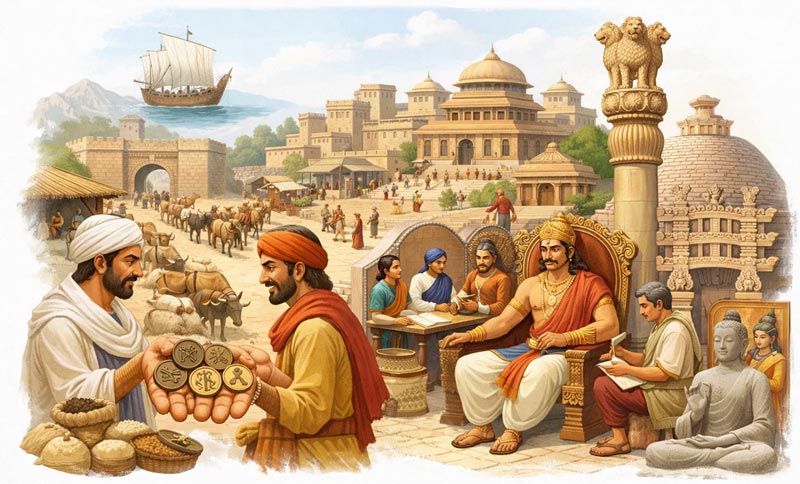
Chapter 5, titled The Rise of Empires, is part of the unit Tapestry of the Past from the Class 7 NCERT textbook Exploring Society: India and Beyond (Part 1). It widely covers how small kingdoms in ancient India gave way to vast empires. It covering the period roughly from the 6th to the 2nd century BCE.
Lets have a look at The Rise of Empires chapter from social studies NCERT class 7 book important notes –
- What an empire is: Many smaller kingdoms under one powerful ruler, who controls them from a central capital.
- Features of an empire: Armies, tax collection, trade control, laws, currency, and support for art and learning.
- Magadha’s rise: This was one of the sixteen Mahajanapadas. It had fertile plains, iron ore, and strong rivers. All these gave it a natural edge over rivals.
- King Ajatashatru (around 5th century BCE): Helped Magadha grow into a dominant power. The Buddha and Mahavira both lived in his time.
- The Nanda dynasty (around 5th century BCE): Mahapadma Nanda brought many kingdoms under one rule and began issuing coins. His successor, Dhana Nanda lost public support through heavy taxation and oppression.
- Panini (around 5th century BCE): Lived during the Nanda period. His work Ashtadhyayi set down the rules of Sanskrit grammar in 3,996 sutras.
- Trade routes and guilds: Traders formed guilds called shrenīs to work together. The Uttarapatha and Dakshinapatha were two major routes linking different parts of India.
- Alexander’s campaign (334-323 BCE): Marched from Macedonia to Persia and into India. Defeated Porus in Punjab but turned back when his exhausted army refused to go further. He later died in Babylon at 32.
- Chandragupta Maurya (around 321 BCE): Chandragupta toppled the Nandas and built the Maurya Empire with Pataliputra as his capital. He was guided closely by Kautilya also known as Chanakya or Vishnugupta.
- Kautilya’s Arthashastra: A detailed guide to running a kingdom, covering defence, taxation, trade, justice, and the Saptanga, the seven pillars of a stable state.
- Megasthenes and Indika: A Greek diplomat at Chandragupta’s court who wrote about Indian society, governance, and daily life in his book Indika.
- Ashoka (268-232 BCE): Took the Maurya Empire to its greatest extent, then walked away from war after the bloodshed at Kalinga and turned toward dharma and non-violence.
- Ashoka’s edicts: Messages carved on rocks and pillars across the empire in Prakrit, using the Brahmi script, urging people to live with kindness, fairness, and tolerance.
- Sarnath Lion Capital: Erected by Ashoka at Sarnath where the Buddha first taught. Today it is India’s national emblem, and the dharmachakra from it sits at the centre of the national flag.
- Life in Mauryan cities: Cities had planned streets, wooden houses up to two storeys tall, active markets, and courier networks for communication.
- Decline of the Maurya Empire (around 185 BCE): After Ashoka, no ruler could hold such a vast territory together. Tributary kingdoms broke free, and the empire gradually fell apart.
This chapter gives you a deep insights about how the Maurya Empire did not just conquer land. It established India’s first large-scale administrative system. A tradition of welfare-oriented governance, and enduring symbols like the Lion Capital and the dharmachakra. Studying this period helps students understand how power, trade, and ideas shaped a civilisation that still has a huge impact on modern India.
Put your knowledge to the test with these MCQ questions for Class 7 Social Science and see how much of this chapter you have truly understood.
Class 7 The Rise of Empires MCQ Questions with Answers
Class 7 SST Chapter 5 The Rise of Empires MCQ Questions
1. What is an empire?
a) A small village ruled by elders
b) A collection of smaller kingdoms or territories under a powerful ruler
c) A group of traders working together
d) A religious institution run by monks
Answer:
b) A collection of smaller kingdoms or territories under a powerful ruler
2. The word ‘empire’ comes from the Latin word ‘imperium’, which means
a) sacred law
b) great wealth
c) supreme power
d) royal city
Answer:
c) supreme power
3. In an empire, the smaller territories generally remained under their own rulers but became
a) independent republics
b) tributaries to the emperor
c) forest settlements
d) guild-controlled regions
Answer:
b) tributaries to the emperor
4. Which of the following is not mentioned in the chapter as a form of tribute?
a) Grain
b) Livestock
c) Elephants
d) Printed books
Answer:
d) Printed books
5. Which title used in ancient Sanskrit texts means ‘king of kings’?
a) Rajaguru
b) Rajadhiraja
c) Mahamatya
d) Purohita
Answer:
b) Rajadhiraja
6. A major centre of economic and administrative power in an empire was usually its
a) monastery
b) battlefield
c) capital
d) marketplace only
Answer:
c) capital
7. Which of the following was one important reason kings wanted to expand into empires?
a) To avoid all responsibility
b) To reduce trade and revenue
c) To gain access to more resources and increase strength
d) To end the use of roads and rivers
Answer:
c) To gain access to more resources and increase strength
8. Which feature was essential for maintaining an empire according to the chapter?
a) Refusing to build roads
b) Maintaining an army
c) Stopping trade completely
d) Avoiding all laws
Answer:
b) Maintaining an army
9. Why was controlling trade routes important for emperors?
a) It reduced the variety of goods
b) It helped destroy local production
c) It increased economic power and tax collections
d) It prevented contact with distant lands
Answer:
c) It increased economic power and tax collections
10. Which of the following was not listed in the chapter as an important traded good in ancient India?
a) Textiles
b) Spices
c) Gems
d) Motor vehicles
Answer:
d) Motor vehicles
11. Guilds or shrenīs were associations mainly formed by
a) emperors and princes
b) traders, craftsmen, moneylenders, or agriculturists
c) monks and philosophers only
d) soldiers living on frontiers
Answer:
b) traders, craftsmen, moneylenders, or agriculturists
12. One remarkable feature of guilds was that they
a) depended entirely on the king for their internal rules
b) discouraged cooperation among members
c) had some autonomy to create their own internal rules
d) worked only in one small city
Answer:
c) had some autonomy to create their own internal rules
13. Which kingdom rose in importance between the 6th and 4th century BCE and set the stage for India’s first empire?
a) Kosala
b) Magadha
c) Avanti
d) Kalinga
Answer:
b) Magadha
14. Which factor did not contribute to the rise of Magadha?
a) Fertile land in the Ganga plains
b) Abundant forests and elephants
c) Nearby minerals and iron ore
d) Isolation from trade routes and rivers
Answer:
d) Isolation from trade routes and rivers
15. Mahapadma Nanda is known for
a) founding the Maurya dynasty
b) founding the Nanda dynasty and extending Magadha
c) defeating Chandragupta Maurya
d) writing Indika
Answer:
b) founding the Nanda dynasty and extending Magadha
16. Why did Dhana Nanda become unpopular according to the chapter?
a) He gave too much power to village councils
b) He refused to mint coins
c) He oppressed and exploited his people
d) He abandoned Magadha’s capital
Answer:
c) He oppressed and exploited his people
17. Alexander defeated Porus in
a) Bengal
b) Punjab
c) Gujarat
d) Kalinga
Answer:
b) Punjab
18. Why did Alexander’s soldiers refuse to march deeper into India?
a) They wanted to settle in Taxila permanently
b) They were tired, homesick, and unwilling to continue
c) They had no contact with Porus
d) They had been ordered back by Chandragupta Maurya
Answer:
b) They were tired, homesick, and unwilling to continue
19. Who founded the Maurya Empire around 321 BCE?
a) Ashoka
b) Mahapadma Nanda
c) Chandragupta Maurya
d) Porus
Answer:
c) Chandragupta Maurya
20. Which Greek diplomat wrote about India in a work called Indika?
a) Seleucus
b) Megasthenes
c) Herodotus
d) Ptolemy
Answer:
b) Megasthenes
21. Kautilya’s famous work Arthashastra deals mainly with
a) sculpture and painting
b) governance and economics
c) medical treatment only
d) astronomy and mathematics
Answer:
b) governance and economics
22. Which Mauryan ruler gave up violence after the Kalinga war and followed the path of peace?
a) Bindusara
b) Chandragupta Maurya
c) Ashoka
d) Dhana Nanda
Answer:
c) Ashoka
23. Ashoka’s edicts were mostly written in
a) Sanskrit in Devanagari
b) Prakrit in Brahmi script
c) Greek in Roman script
d) Tamil in Grantha script
Answer:
b) Prakrit in Brahmi script
The Rise of Empires Class 7 Assertion-Reason Questions
1. Assertion (A): Empires needed strong economic activity to survive. Reason (R): Maintaining armies, roads, ships, and administration required resources and revenue.
a) Both A and R are true, and R is the correct explanation of A
b) Both A and R are true, but R is not the correct explanation of A
c) A is true, but R is false
d) A is false, but R is true
Answer:
a) Both A and R are true, and R is the correct explanation of A
2. Assertion (A): Guilds were important institutions in ancient India. Reason (R): They brought together traders and craftsmen, and often had autonomy to frame internal rules.
a) Both A and R are true, and R is the correct explanation of A
b) Both A and R are true, but R is not the correct explanation of A
c) A is true, but R is false
d) A is false, but R is true
Answer:
a) Both A and R are true, and R is the correct explanation of A
3. Assertion (A): Magadha rose to power partly because of geography. Reason (R): Its fertile plains, forests, elephants, rivers, and nearby iron ore strengthened both agriculture and warfare.
a) Both A and R are true, and R is the correct explanation of A
b) Both A and R are true, but R is not the correct explanation of A
c) A is true, but R is false
d) A is false, but R is true
Answer:
a) Both A and R are true, and R is the correct explanation of A
4. Assertion (A): Kautilya believed a king should promote the welfare of his subjects. Reason (R): The strength of the kingdom depended on prosperous people and a productive countryside.
a) Both A and R are true, and R is the correct explanation of A
b) Both A and R are true, but R is not the correct explanation of A
c) A is true, but R is false
d) A is false, but R is true
Answer:
a) Both A and R are true, and R is the correct explanation of A
5. Assertion (A): Ashoka is often called a great communicator. Reason (R): He had messages engraved on rocks and pillars across many parts of his empire.
a) Both A and R are true, and R is the correct explanation of A
b) Both A and R are true, but R is not the correct explanation of A
c) A is true, but R is false
d) A is false, but R is true
Answer:
a) Both A and R are true, and R is the correct explanation of A
The Rise of Empires Class 7 Fill in the blanks Questions
1. A ruler or state that submits to an emperor and pays tribute is called a __________.
Answer:
tributary
2. The powerful associations of traders and craftsmen were called __________.
Answer:
guilds
3. The kingdom that rose in importance before India’s first empire was __________.
Answer:
Magadha
4. Mahapadma Nanda founded the __________ dynasty.
Answer:
Nanda
5. Alexander was a Greek king from __________.
Answer:
Macedonia
6. Chandragupta Maurya established his rule with Paṭaliputra as his __________.
Answer:
capital
7. The Greek diplomat who wrote Indika was __________.
Answer:
Megasthenes
8. Kautilya’s theory of the seven parts of a kingdom is called the __________.
Answer:
Saptanga
9. After the Kalinga war, Ashoka chose the path of peace and __________.
Answer:
non-violence
10. Ashoka’s messages engraved on rocks and pillars are called __________.
Answer:
edicts
The Rise of Empires Class 7 True or False Questions
1. In an empire, all smaller rulers always lost every form of local authority immediately.
Answer:
False
2. Empires often maintained communication networks such as roads and river routes.
Answer:
True
3. Guilds were weak associations that had no long-term influence on Indian society.
Answer:
False
4. Ajatashatru is mentioned as an early king who helped Magadha rise in importance.
Answer:
True
5. Dhana Nanda remained popular because he ruled with fairness and humility.
Answer:
False
6. Alexander died in Babylon at the age of 32.
Answer:
True
7. Kautilya is also referred to in some texts as Chaṇakya or Viṣhṇugupta.
Answer:
True
8. According to Kautilya, the king’s happiness was more important than the welfare of the subjects.
Answer:
False
9. Ashoka’s edicts encouraged people to follow dharma.
Answer:
True
10. The Maurya Empire broke apart immediately during Ashoka’s lifetime.
Answer:
False
The Rise of Empires Class 7 Match the following Questions
Question 1
| Column A | Column B |
|---|---|
| 1. Tributary | A. Powerful association of traders or craftsmen |
| 2. Guild | B. Official declaration issued by a king |
| 3. Satrap | C. Ruler or state paying tribute to an emperor |
| 4. Edict | D. Governor of a province in Persian or Greek empires |
| 5. Emissary | E. Person sent on a special mission |
Answer:
| Column A | Correct Answer |
|---|---|
| 1. Tributary | C. Ruler or state paying tribute to an emperor |
| 2. Guild | A. Powerful association of traders or craftsmen |
| 3. Satrap | D. Governor of a province in Persian or Greek empires |
| 4. Edict | B. Official declaration issued by a king |
| 5. Emissary | E. Person sent on a special mission |
Question 2
| Column A | Column B |
|---|---|
| 1. Mahapadma Nanda | A. Wrote Indika |
| 2. Megasthenes | B. Gave up violence after Kalinga war |
| 3. Chandragupta Maurya | C. Founded the Nanda dynasty |
| 4. Ashoka | D. Founder of the Maurya Empire |
| 5. Arthashastra | E. Work on governance and economics |
Answer:
| Column A | Correct Answer |
|---|---|
| 1. Mahapadma Nanda | C. Founded the Nanda dynasty |
| 2. Megasthenes | A. Wrote Indika |
| 3. Chandragupta Maurya | D. Founder of the Maurya Empire |
| 4. Ashoka | B. Gave up violence after Kalinga war |
| 5. Arthashastra | E. Work on governance and economics |
Related Class 7 History Chapters
Follow India’s past in order through these history chapters:
- New Beginnings: Cities and States MCQs
- The Age of Reorganisation MCQs
- The Gupta Era MCQs
- Empires and Kingdoms: 6th to 10th Centuries MCQs
- Turning Tides: 11th and 12th Centuries MCQs
Next chapter: Chapter 6 – The Age of Reorganisation
See all chapters: Class 7 Social Science MCQ – All Chapters
