
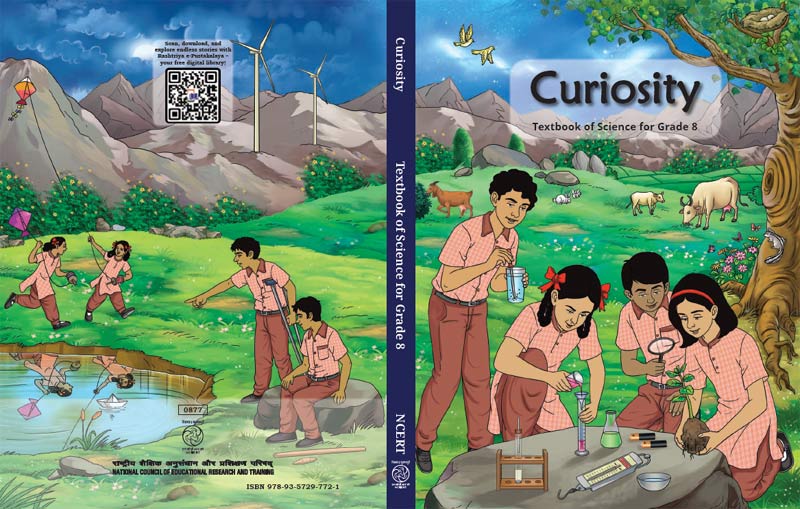
Welcome to a complete guide for Class 8 Science MCQ questions. These questions are based on the new NCERT book Curiosity to help you study effectively. The content focuses on key topics and concepts from each chapter.
These MCQs are designed to improve your understanding and help you test your knowledge. They make learning easier and prepare you for exams. Below we have added all the essential topics for each chapter with direct links to MCQs for quick access.
In the Class 8, the science textbook is about a wider and more connected view of the world. The chapters are not just about facts. The chapters deal with daily life, nature, health, materials, energy, weather, and the universe.
In Biology, students learn about living things at different levels. They begin with the world of plants, food, and crop production. They also explore microorganisms, health, and the importance of good habits for staying fit. These chapters show how tiny living organisms can be both useful and harmful. They also help students understand disease prevention, nutrition, and the balance of life around us.
In Physics, the chapters explain many things students see every day. They learn about electricity and its heating and magnetic effects. They study force and pressure, and how these ideas affect movement, wind, storms, and cyclones. The book also has chapters on light through mirrors and lenses. In addition, students learn how we observe the sky and measure time using natural patterns.
In Chemistry, the chapter starts with matter in a more scientific way. They learn that matter is made of tiny particles. Further elements, compounds, and mixtures is covered. In addition the other chapter deals with solutes, solvents, and solutions through simple examples from daily life. These chapters build a strong base for higher classes and make chemical concepts easier to follow in senior classes.
The book also includes chapters that connect science to the environment and to Earth. Students learn how nature works. Further thete is a knowledge base on why balance in ecosystems is important.
Overall, Class 8 Science builds “Curiosity” and clear thinking. It connects biology, physics, chemistry, and environmental science in a simple way.
Below, you will find 13 chapters from the Class 8 Science textbook. This guide makes learning stress-free and fun, whether revising for exams or brushing up on Science. Start practicing today and sharpen your skills!
Class 8 Science MCQ Questions with Answers – All 13 Chapters
Pick any chapter below to practice NCERT-based multiple choice questions with answers for CBSE Class 8 Science.
- Class 8 Science Chapter 1 Exploring the Investigative World of Science MCQ Questions and Answers
- Class 8 Science Chapter 2 The Invisible Living World: Beyond Our Naked Eye MCQ Questions and Answers
- Class 8 Science Chapter 3 Health: The Ultimate Treasure MCQ Questions and Answers
- Class 8 Science Chapter 4 Electricity: Magnetic and Heating Effects MCQ Questions and Answers
- Class 8 Science Chapter 5 Exploring Forces MCQ Questions and Answers
- Class 8 Science Chapter 6 Pressure, Winds, Storms, and Cyclones MCQ Questions and Answers
- Class 8 Science Chapter 7 Particulate Nature of Matter MCQ Questions and Answers
- Class 8 Science Chapter 8 Nature of Matter: Elements, Compounds, and Mixtures MCQ Questions and Answers
- Class 8 Science Chapter 9 The Amazing World of Solutes, Solvents, and Solutions MCQ Questions and Answers
- Class 8 Science Chapter 10 Light: Mirrors and Lenses MCQ Questions and Answers
- Class 8 Science Chapter 11 Keeping Time with the Skies MCQ Questions and Answers
- Class 8 Science Chapter 12 How Nature Works in Harmony MCQ Questions and Answers
- Class 8 Science Chapter 13 Our Home: Earth, a Unique Life Sustaining Planet MCQ Questions and Answers
List of Chapters with Topics Covered
Chapter 1: Exploring the Investigative World of Science
- Scientific inquiry and curiosity
- Observation, questions, and experiments
- Health, nutrition, and microbes
- Force, pressure, and electricity
- Matter, materials, and light
- Earth, environment, and space
Chapter 2: The Invisible Living World: Beyond Our Naked Eye
- Microscopes and the invisible world
- Cells and their basic structure
- Plant and animal cells
- Types of microorganisms
- Useful microbes in daily life
- Cells as the unit of life
Chapter 3: Health: The Ultimate Treasure
- Meaning and importance of health
- Healthy habits and clean surroundings
- Signs, symptoms, and causes of disease
- Communicable and non-communicable diseases
- Disease prevention, immunity, and vaccines
- Medicines, antibiotics, and antibiotic resistance
Chapter 4: Electricity: Magnetic and Heating Effects
- Magnetic effect of electric current
- Electromagnets and their uses
- Heating effect of electric current
- Lifting electromagnets
- Voltaic cells and lemon cells
- Dry cells and rechargeable batteries
Chapter 5: Exploring Forces
- Meaning and effects of force
- Contact and non-contact forces
- Friction, magnetic, and electrostatic force
- Gravitational force and weight
- Mass and spring balance measurement
- Floating, sinking, and buoyant force
Chapter 6: Pressure, Winds, Storms, and Cyclones
- Pressure and its effects
- Pressure in liquids and air
- Formation of winds
- Storms, thunderstorms, and lightning
- Cyclones and their effects
- Safety during lightning and cyclones
Chapter 7: Particulate Nature of Matter
- Matter is made of tiny particles
- States of matter: solid, liquid, and gas
- Interparticle spaces and attractions
- Properties of solids, liquids, and gases
- Movement of particles in matter
- Effect of heat on states of matter
Chapter 8: Nature of Matter: Elements, Compounds, and Mixtures
- Mixtures and their types
- Pure substances
- Elements and atoms
- Compounds and fixed ratios
- Difference between mixtures and compounds
- Minerals and their uses
Chapter 9: The Amazing World of Solutes, Solvents, and Solutions
- Solute, solvent, and solution
- Uniform and non-uniform mixtures
- Saturated and unsaturated solutions
- Solubility and effect of temperature
- Density, floating, and sinking
- Measuring mass and volume
Chapter 10: Light: Mirrors and Lenses
- Production and propagation of sound
- Properties of sound waves
- Human ear and its functions
- Noise pollution and its effects
Chapter 11: Keeping Time with the Skies
- Phases of the Moon
- Moon’s movement in the sky
- Day, month, and year
- Lunar, solar, and luni-solar calendars
- Indian National Calendar and festivals
- Artificial satellites and their uses
Chapter 12: How Nature Works in Harmony
- Habitats and their components
- Population, community, and ecosystem
- Food chains and food webs
- Producers, consumers, and decomposers
- Balance in ecosystems
- Human impact on nature
Chapter 13: Our Home: Earth, a Unique Life Sustaining Planet
- Earth as a life-supporting planet
- Why Earth is unique in the solar system
- Conditions needed for life on Earth
- Reproduction and continuity of life
- Balance between air, water, soil, and living things
- Climate change, pollution, and threats to life

1 Comment
it is very useful yo me