
Short moral stories in English are small, simple stories that end with a lesson, called a moral. They help children learn good values like sharing, honesty, kindness and patience, while also improving their English and listening skills.
Here are 20 original short stories for kids, set in homes, schools and gardens that Indian children will find familiar. The first 10 are very short stories for little ones aged 2 to 4. The next 10 are slightly longer stories for kids aged 5 to 8. Each story ends with a moral and a simple question you can ask your child.
Quick List: 20 Short Stories and Their Morals
| Story | Moral |
|---|---|
| Motu the Puppy Shares His Ball | Sharing makes playing more fun |
| Pinky Says Sorry | Saying sorry makes things right |
| Tara Brushes Her Teeth | Good habits keep us healthy |
| The Little Duck Who Was Scared of Water | Be brave and try new things |
| Chintu Puts His Toys Away | Clean up after you play |
| Mini the Cat Waits Her Turn | Good things come to those who wait |
| Baby Elephant Says Thank You | Always say thank you |
| The Sleepy Sun and the Moon | Rest helps us feel fresh and strong |
| Appu Eats His Vegetables | Healthy food makes us strong |
| The Little Sparrow Helps a Friend | Help your friends when they need you |
| Arjun and the Lost Wallet | Honesty is the best policy |
| The Tap That Kept Running | Every drop of water is precious |
| Ananya’s Broken Crayon | Make the best of what you have |
| The New Girl in Class | Be kind to someone who is new |
| Rohan and the Kite | Never give up |
| The Proud Mango Tree | Pride comes before a fall |
| Dadi’s Little Garden | Hard work always pays off |
| The Squirrel Who Saved for the Rain | Save today for tomorrow |
| Isha and the Stray Puppy | Be kind to animals |
| Two Friends and the Last Samosa | True friends share fairly |
Very Short Stories in English for Ages 2 to 4
These small stories for kids use easy words and short lines. Read them slowly, point at the pictures, and let your little one join in with the sounds.
1. Motu the Puppy Shares His Ball
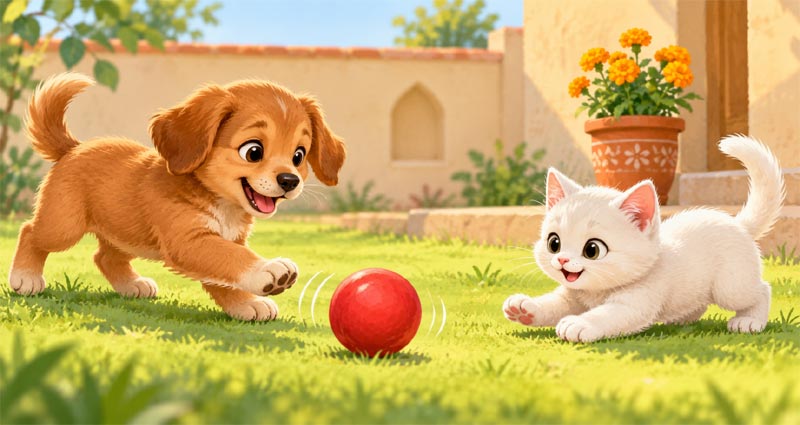
Motu the puppy had a red ball. He loved it very much. He threw it up. He ran after it. He rolled it on the grass.
Then Moti the kitten came by. She looked at the ball with big eyes. “Can I play too?” she asked.
Motu thought for a moment. Then he rolled the ball to her. Moti rolled it back. Roll, roll, roll! They laughed and played all afternoon.
Moral: Sharing makes playing more fun.
Ask your child: Which toy would you share with your friend?
2. Pinky Says Sorry
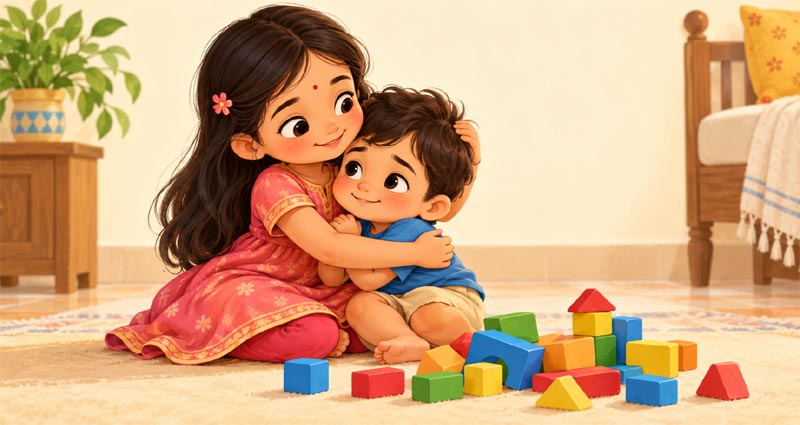
Pinky and her brother Bittu were building a tall tower with blocks.
Pinky wanted to add one more block. Oops! She bumped the tower, and it fell down. Bittu started to cry.
Pinky felt sad. She gave Bittu a hug and said, “I am sorry, Bittu. Let’s build it again together.”
Bittu wiped his tears and smiled. This time, they built an even taller tower!
Moral: Saying sorry makes things right.
Ask your child: What do you say when you make a mistake?
3. Tara Brushes Her Teeth
Every night, Mumma said, “Tara, time to brush your teeth!” But Tara did not want to.
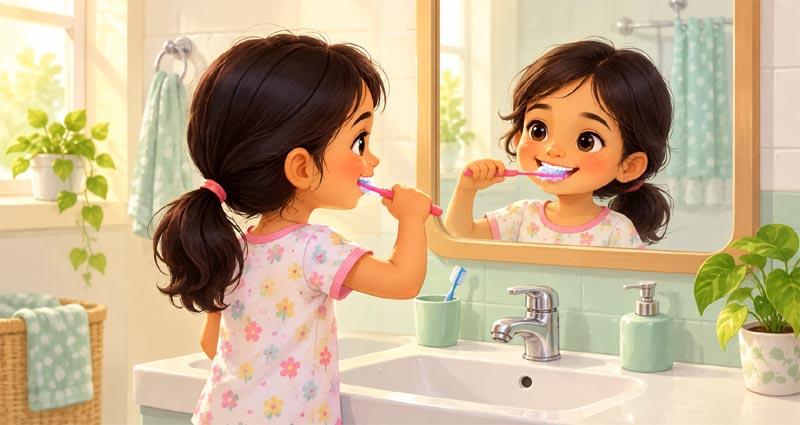
One night, Tara looked in the mirror. She saw a tiny bit of chocolate stuck on her tooth. “Oh no!” she said.
Tara picked up her pink toothbrush. Brush, brush, brush! Up and down, round and round. Soon her teeth were clean and shiny.
Tara gave the mirror a big smile. “Now I will brush every night!” she said.
Moral: Good habits keep us healthy.
Ask your child: When do you brush your teeth?
4. The Little Duck Who Was Scared of Water
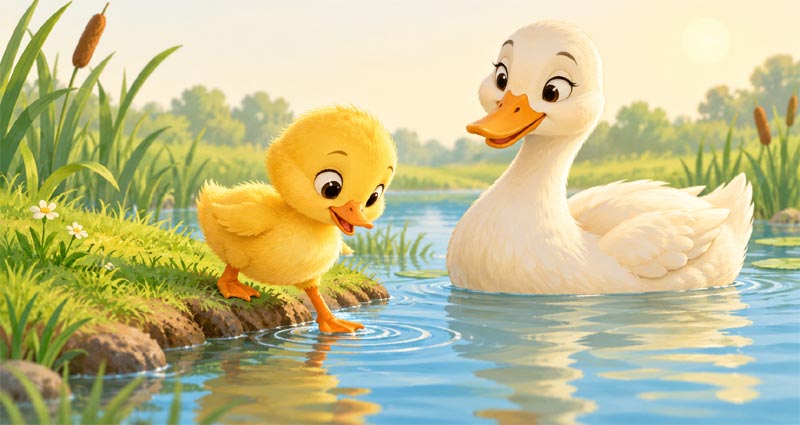
Daisy was a little duck. Her brothers and sisters swam happily in the pond. But Daisy stood on the bank. “The water looks so big,” she said.
Mother Duck came close. “Just put one foot in,” she said softly.
Daisy put one foot in. It felt cool and nice. Then she put in the other foot. Splash! Soon Daisy was swimming with everyone. Quack, quack, quack!
Moral: Be brave and try new things.
Ask your child: What new thing did you try this week?
5. Chintu Puts His Toys Away
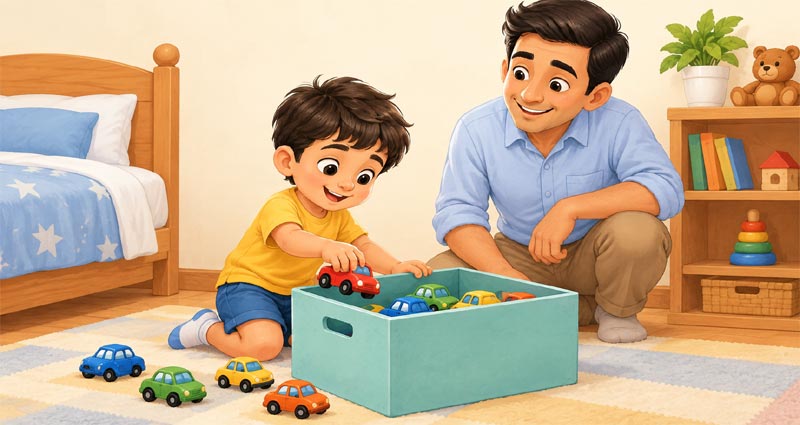
Chintu played with his cars, his blocks and his teddy. Soon the floor was full of toys.
Papa walked in and stepped on a little car. “Ouch!” he said.
Chintu ran to help. He put the cars in the box. He put the blocks on the shelf. He put Teddy on the bed.
“Thank you, Chintu,” said Papa. “Now our room is neat and safe.” Chintu felt very proud.
Moral: Clean up after you play.
Ask your child: Where do your toys go after playtime?
6. Mini the Cat Waits Her Turn
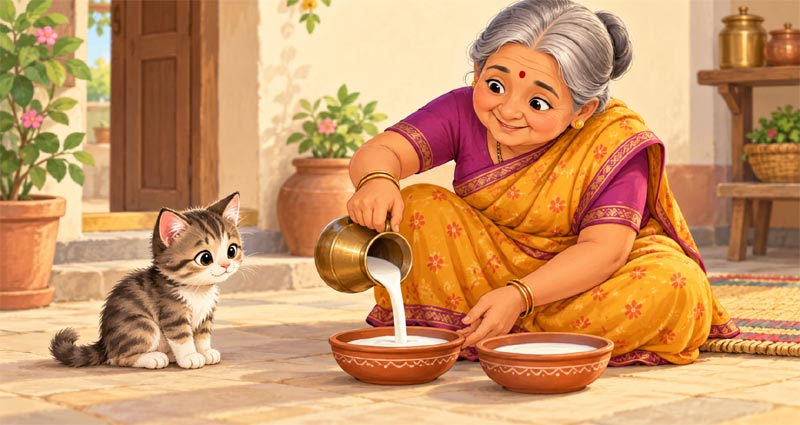
Mini the cat was very hungry. Grandma was pouring milk into bowls for all the kittens.
Mini wanted her milk first. She jumped and meowed. Grandma said, “Wait for your turn, Mini.”
Mini sat down quietly. One bowl, two bowls, three bowls. Then Grandma filled the last bowl and gave it to Mini. It was the biggest bowl of all! Mini purred happily and drank it all up.
Moral: Good things come to those who wait.
Ask your child: Can you wait for your turn on the slide?
7. Baby Elephant Says Thank You
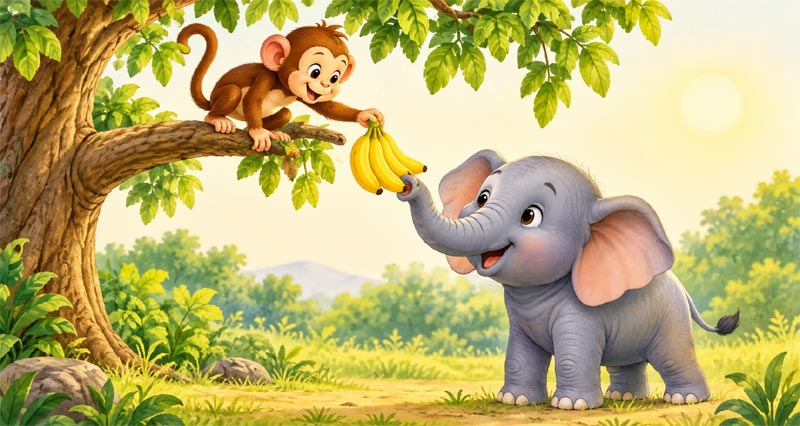
Baby Elephant wanted to eat the bananas high up on the tree. He stretched his little trunk, but he could not reach them.
Monkey saw him and climbed the tree. He picked a big bunch of bananas and gave it to Baby Elephant.
Baby Elephant was so happy. He waved his trunk and said, “Thank you, Monkey!” Monkey smiled. “You are welcome, my friend!”
Moral: Always say thank you when someone helps you.
Ask your child: Who did you say thank you to today?
8. The Sleepy Sun and the Moon

All day long, the Sun shone bright and warm. The children played, and the birds sang.
In the evening, the Sun gave a big yawn. “I am tired,” he said. “Moon, will you look after the sky?”
“Yes!” said the Moon, and she came out with her twinkling stars. The Sun went to sleep behind the hills.
The next morning, the Sun woke up fresh and happy, ready to shine again.
Moral: Rest helps us feel fresh and strong.
Ask your child: What do you do before you go to sleep?
9. Appu Eats His Vegetables

Appu did not like vegetables. He pushed the carrots and beans to the side of his plate.
Nani said, “Appu, carrots help your eyes. Beans make your legs strong for running.”
Appu took one small bite of carrot. Crunch! It was sweet! Then he tried the beans. Yummy!
The next day, Appu ran faster than all his friends in the park. “Vegetables make me strong!” he shouted.
Moral: Healthy food makes us strong.
Ask your child: Which vegetable do you like the most?
10. The Little Sparrow Helps a Friend
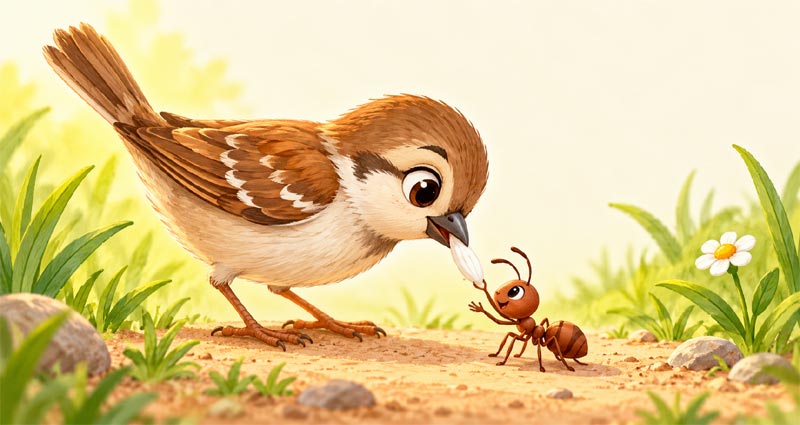
Chinki the sparrow was building a nest. She carried twigs one by one.
Nearby, a little ant was trying to carry a big grain of rice. It was too heavy. The ant puffed and panted.
Chinki flew down. She picked up the grain in her beak and carried it to the ant’s home. “Thank you, Chinki!” said the ant happily.
Chinki sang a sweet song and went back to building her nest.
Moral: Help your friends when they need you.
Ask your child: How did you help someone today?
Short Moral Stories in English for Ages 5 to 8
These English stories for kids are a little longer, with more events and feelings. Children in Class 1 to Class 3 can read them on their own or with a little help.
11. Arjun and the Lost Wallet: Short Story in English with Moral
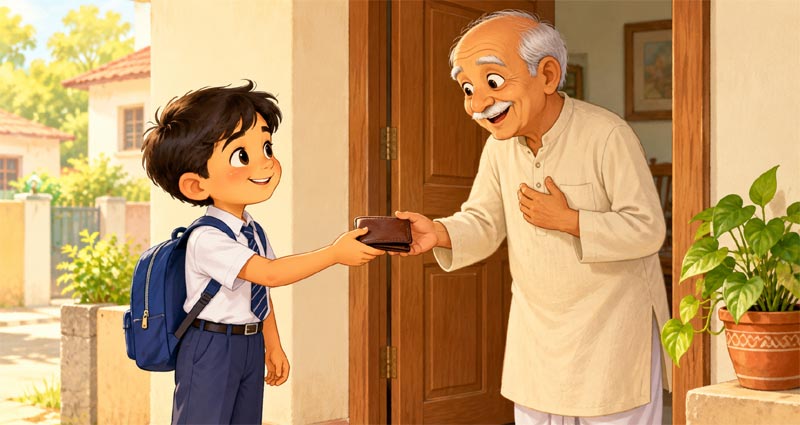
Arjun was walking home from school when he saw a brown wallet lying near the bus stop. He picked it up and looked inside. There was a lot of money, a family photo and a card with an address.
For a moment, Arjun thought about the new cricket bat he wanted. But then he shook his head. “This money belongs to someone else,” he said.
He took the wallet home and told his mother. Together, they went to the address on the card. An old man opened the door. When he saw the wallet, his eyes filled with happy tears. “I was so worried! This money was for my wife’s medicines,” he said.
He thanked Arjun again and again. Arjun walked home feeling happier than any cricket bat could make him.
Moral: Honesty is the best policy.
Ask your child: What would you do if you found something that was not yours?
12. The Tap That Kept Running
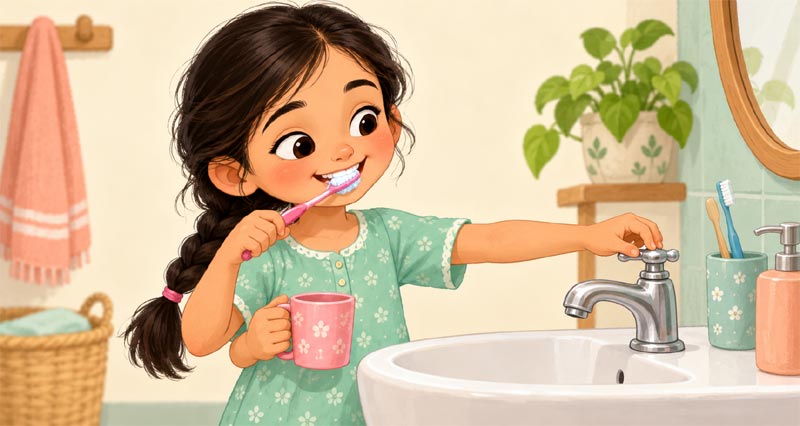
Every morning, Kavya brushed her teeth with the tap running. Drip, drip, splash! The water kept flowing down the drain.
One summer, there was very little water in the town. Kavya saw people standing in a long line with buckets, waiting for the water tanker. A little girl her age was carrying a heavy bucket and looked very tired.
That evening, Kavya asked her father, “Papa, why is there so little water?” He said, “Water is precious, beta. When we waste it, others may not get enough.”
The next morning, Kavya filled a small mug and turned off the tap while brushing. She told her friends to do the same. Soon, her whole class started a “Save Water” club.
Moral: Every drop of water is precious. Save water.
Ask your child: How can you save water at home?
13. Ananya’s Broken Crayon
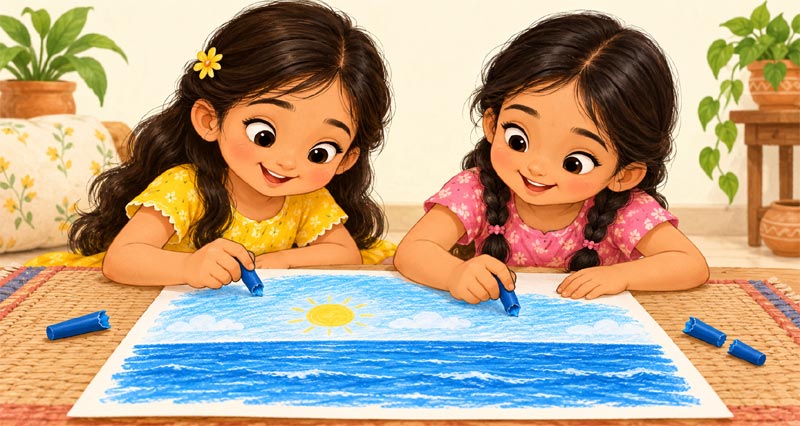
Ananya had a new box of crayons. Her favourite was the blue one. One day, while drawing, she pressed too hard. Snap! The blue crayon broke into two pieces.
Ananya started to cry. “Now I cannot colour the sky!”
Her big sister Meera sat beside her. “Look, Ananya,” she said. “Now you have two blue crayons instead of one. You can even share one with me!”
Ananya looked at the pieces. She picked up the small one and started to colour. The sky looked just as blue as before. Then she gave the other piece to Meera, and they coloured a big blue ocean together.
At the end of the day, their picture was the most beautiful one they had ever made.
Moral: Make the best of what you have.
Ask your child: What can you make from something that is broken?
14. The New Girl in Class: Small Story for Kids in English
One Monday, a new girl named Sana joined Class 2. She stood near the door, holding her bag tightly. She did not know anyone.
At lunchtime, Sana sat alone in a corner. The other children were laughing and eating together. Nobody called her.
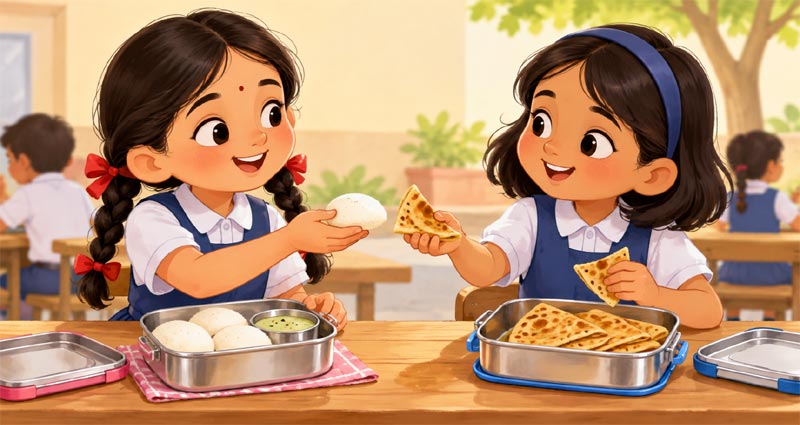
Diya noticed Sana sitting by herself. She remembered her own first day at a new school and how scared she had felt. She picked up her lunch box and walked over. “Hi, I am Diya. Can I sit with you?”
Sana’s face lit up. They shared their lunch. Sana had brought idlis, and Diya had brought parathas. They talked and laughed. By the end of the day, Diya had introduced Sana to all her friends.
Soon, Sana was not the new girl anymore. She was everyone’s friend.
Moral: Be kind to someone who is new.
Ask your child: How would you make a new friend feel welcome?
15. Rohan and the Kite

It was Makar Sankranti, and the sky was full of colourful kites. Rohan had a new red kite. He ran with it, but it fell to the ground. He tried again. It wobbled and fell again.
His friends laughed. “Your kite will never fly!” Rohan felt like giving up.
His grandfather came up to the terrace. “Let me show you,” he said. “Run against the wind. Let the string out slowly. And be patient.”
Rohan tried once more. He ran against the wind and let the string out bit by bit. This time, the red kite rose higher and higher, until it was dancing among the clouds.
“I did it!” shouted Rohan. His friends clapped. Grandpa smiled. “You did it because you did not give up.”
Moral: Never give up.
Ask your child: What is something you learnt by trying again and again?
16. The Proud Mango Tree: English Story for Kids

In a village garden, there stood a tall mango tree and a small tulsi plant. The mango tree was full of sweet mangoes, and it was very proud.
“Look at me,” it said. “I am so tall and strong. You are just a tiny plant.” The tulsi plant said nothing.
One night, a big storm came. The wind blew hard. The mango tree stood stiff and proud, and many of its branches broke and fell. The little tulsi plant bent low with the wind and was not hurt at all.
In the morning, the mango tree looked at its broken branches. It said softly to the tulsi, “You were wise to bend. I was foolish to be so proud.” From that day, the mango tree was kind to all the small plants in the garden.
Moral: Pride comes before a fall.
Ask your child: Why do you think the little plant was not hurt?
17. Dadi’s Little Garden
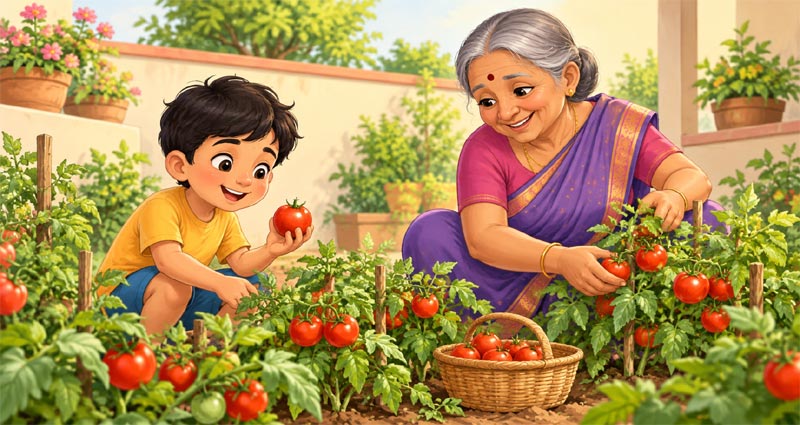
Dadi had a small garden behind the house. One day, she gave Vihaan a packet of tomato seeds. “Plant these, and water them every day,” she said.
Vihaan planted the seeds and watered them. The next day, he ran to check. Nothing! Another day passed. Still nothing. “Dadi, the seeds are not growing,” he complained.
“Keep watering, and be patient,” said Dadi.
So Vihaan kept going. He watered the soil every morning and pulled out the weeds. After two weeks, tiny green plants popped out of the soil. Slowly they grew taller, and little yellow flowers appeared. Then, one day, there were shiny red tomatoes!
That night, Dadi made tomato chutney with Vihaan’s tomatoes. It was the tastiest chutney he had ever eaten.
Moral: Hard work always pays off.
Ask your child: If you could grow something, what would it be?
18. The Squirrel Who Saved for the Rain
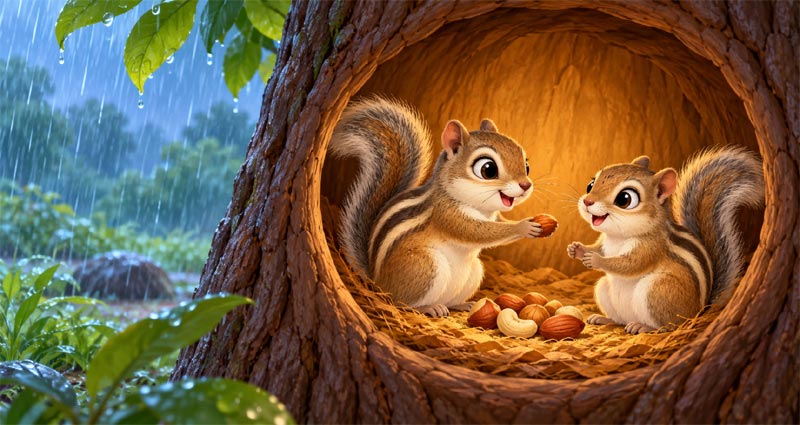
Chunnu the squirrel and his friend Bholu lived in a big neem tree. Every day, Chunnu collected nuts and seeds and stored some in a hole in the tree. Bholu only ate and played.
“Why do you save so much food?” laughed Bholu. “There is plenty everywhere!”
“The rains will come soon,” said Chunnu. “Then it will be hard to find food.”
A few weeks later, the monsoon arrived. It rained day and night. The ground was wet and muddy, and there was no food anywhere. Bholu was hungry and cold.
Chunnu invited him into his cosy hole and shared his nuts. Bholu felt ashamed. “Thank you, Chunnu. From now on, I will also save for the rainy days.”
Moral: Save today for tomorrow.
Ask your child: What would you like to save your pocket money for?
19. Isha and the Stray Puppy
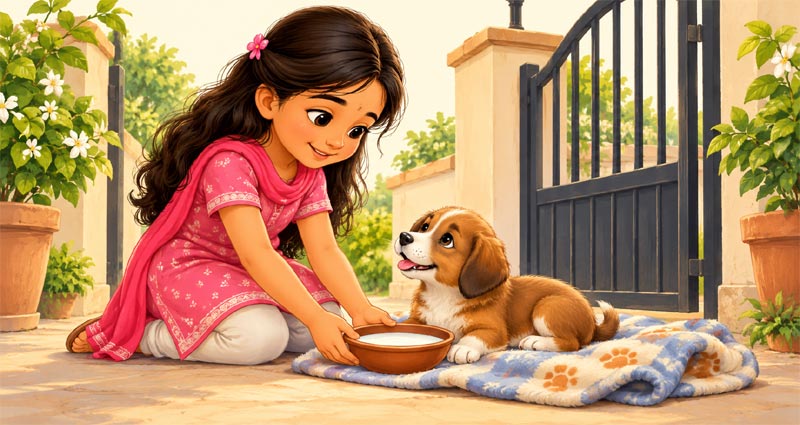
On a cold winter evening, Isha heard a soft crying sound outside her gate. She peeped out and saw a small brown puppy shivering in the corner. It was thin and looked very hungry.
Isha ran inside. “Mumma, there is a puppy outside. It is so cold!” Her mother came out and looked. “Let us help it,” she said.
Isha brought an old blanket and made a warm bed for the puppy near the gate. Her mother gave her a bowl of milk and some roti. The puppy ate everything and wagged its little tail.
Every day after that, Isha fed the puppy. She named him Coco. Soon Coco grew strong and happy. He guarded Isha’s house every night and ran to greet her whenever she came home from school.
Moral: Be kind to animals. They love us back.
Ask your child: How can we help animals on our street?
20. Two Friends and the Last Samosa
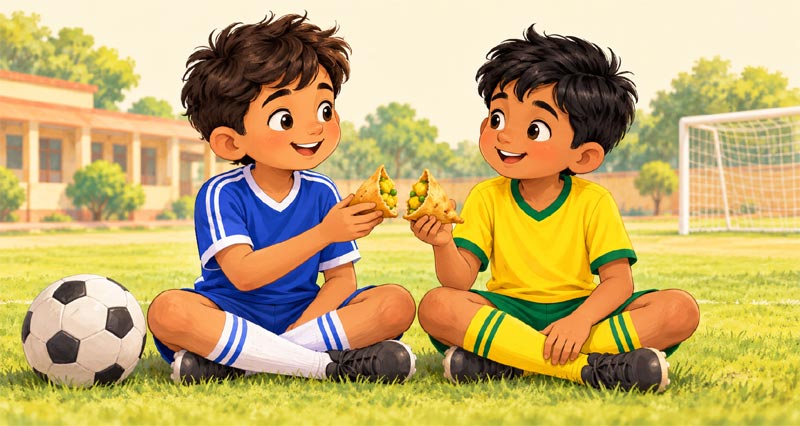
After the school football match, Aarav and Dev were very hungry. Aarav’s mother had packed samosas. They ate one each, and then there was only one left.
Both boys looked at the last samosa. “I scored the goal, so I should get it,” said Dev. “But it is my mother’s samosa,” said Aarav.
They were about to fight when Aarav had an idea. He broke the samosa into two equal halves and gave one half to Dev. Dev smiled and said, “Thank you. Next time, I will bring my mother’s jalebis for both of us.”
They ate their halves happily. The samosa was small, but their friendship felt big.
Moral: True friends share fairly.
Ask your child: How would you share one cookie with a friend?
Tips to Make Story Time Fun
1. Use funny voices. Give each character a different voice. Children love it, and it keeps them listening.
2. Ask what happens next. Pause in the middle and let your child guess. It builds imagination and thinking.
3. Read it again, and again. If your child asks for the same story many times, say yes. Repetition helps them remember new words.
4. Connect the moral to real life. Talk about a time from your child’s own day when they shared, helped or said sorry.
5. Keep a fixed story time. A story before bed every night becomes a happy habit your child will look forward to.
FAQs on Short Moral Stories for Kids
What is a moral story?
A moral story is a short story that teaches a lesson at the end. For example, “Arjun and the Lost Wallet” teaches that honesty is the best policy.
What are some good short moral stories for kids in English?
Some easy and popular choices are “Motu the Puppy Shares His Ball”, “Pinky Says Sorry”, “Rohan and the Kite” and “Two Friends and the Last Samosa”. They are short, simple and teach everyday values.
How long should a story be for a 2 or 3 year old?
For toddlers, a story of 60 to 80 words, or about one to two minutes of reading, is enough. Short lines, repeated sounds and a picture on each page keep them interested.
Why are moral stories important for children?
Moral stories teach values like kindness, honesty and sharing in a way children can easily understand. They also build vocabulary, listening skills and imagination.
Can these stories help children learn English?
Yes. The stories use simple English words and short sentences. Reading them aloud every day helps children learn new words and speak with more confidence.
