
Every year on 26 January, millions of Indians watch the Republic Day parade with pride. But have you ever stopped to wonder what exactly we are celebrating? It is not just a holiday. It marks the day a document came into force that changed the lives of every single person in this country.
Chapter 10, The Constitution of India – An Introduction, is part of the unit Governance and Democracy from the textbook Exploring Society: India and Beyond, Grade 7 Part 1, under the CBSE curriculum. It introduces students to what a constitution is, how India’s Constitution was made, and why it still guides the country more than seventy years later.
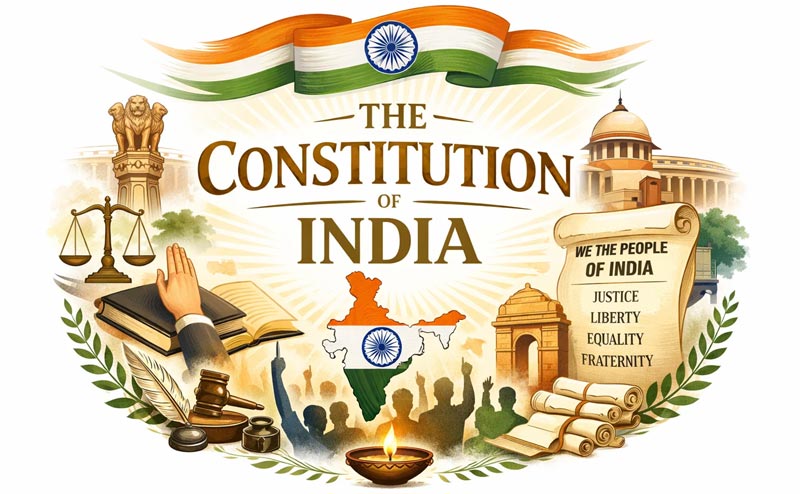
Let’s check out what chapter 10 of the Class 7 NCERT book covers –
- What a constitution is: A document that lays out the basic laws, rights, duties, and goals of a nation for everyone to follow.
- The Constitution came into effect on 26 January 1950: This is why India celebrates Republic Day every year on this date.
- World’s largest written constitution: The Indian Constitution currently has 25 parts and 12 schedules. It originally had 22 parts and 8 schedules when it came into effect.
- Preserved in helium: The original Constitution is kept in a helium-filled glass case in Parliament, as helium does not react with paper or ink.
- The Constituent Assembly, formed 9 December 1946: It had 389 members initially, reduced to 299 after Partition. Of these, 15 were women.
- Dr. Rajendra Prasad: He was the Chairman of the Constituent Assembly and later became India’s first President.
- Dr. B.R. Ambedkar: He chaired the Drafting Committee that prepared the initial text of the Constitution. He was also India’s first Law and Justice Minister.
- Constitution adopted on 26 November 1949: This date is observed as Constitution Day or Samvidhan Divas in India.
- Influences on the Constitution: Ideas came from India’s freedom struggle, civilisational heritage, and constitutions of France, USA, UK, Ireland, Australia, and other democracies.
- From France: The ideals of liberty, equality, and fraternity, rooted in the French Revolution of 1789, were adopted into the Indian Constitution.
- From Ireland: The concept of Directive Principles of State Policy was inspired by the Irish Constitution.
- Fundamental Rights: These are legally enforceable promises, including the right to equality (Article 14), right to life and personal liberty (Article 21), and right to education (Article 21-A).
- Directive Principles of State Policy (DPSP): These are goals the government should work towards, such as social justice and public health, but cannot be enforced in court.
- Fundamental Duties added in 1976: Through the 42nd Constitutional Amendment, Part IV-A was added, listing duties of every Indian citizen.
- Panchayati Raj added in 1992: The 73rd Constitutional Amendment integrated local governance into the Constitution.
- Flying the national flag at home allowed from 2004: A citizen challenged the earlier restriction in court and the Supreme Court ruled it a Fundamental Right under freedom of expression.
- The Preamble: It captures the core values of the Constitution – Sovereign, Socialist, Secular, Democratic, Republic, Justice, Liberty, Equality, and Fraternity. The words Socialist and Secular were added through the 42nd Amendment in 1976.
- The Constitution as art: Calligrapher Prem Behari Narain Raizada wrote the text of the Constitution by hand. Artist Nandalal Bose and his team illustrated the pages with scenes from Indian history.
Chapter 10 is very important for exams and for students’ overall knowledge. The Constitution is not just a legal document. It is what every judge refers to when protecting a citizen’s rights. Every elected official swears to uphold what is written in it. Text and words in it shape laws that affect daily life. Knowing how it was made and what it stands for helps students understand the values India was built on, and what every citizen can do to keep those values alive.
Put your knowledge to the test with our MCQ questions for Class 7 Social Science on this chapter.
Class 7 The Constitution of India An Introduction MCQ Questions with Answers
Class 7 SST Chapter 10 The Constitution of India An Introduction MCQ Questions
1. What is a constitution?
a) A book of stories about rulers
b) A document that lays down the basic principles and laws of a nation
c) A list of taxes collected by the government
d) A rulebook used only in courts
Answer:
b) A document that lays down the basic principles and laws of a nation
2. The Constitution of India came into effect on
a) 15 August 1947
b) 26 November 1949
c) 26 January 1950
d) 9 December 1946
Answer:
c) 26 January 1950
3. India celebrates Republic Day on 26 January because on that day
a) the Constituent Assembly was formed
b) the Constitution came into force
c) India became independent
d) the first general election was held
Answer:
b) the Constitution came into force
4. Which of the following is not listed in the chapter as something a constitution lays out?
a) Rights and duties of citizens
b) Roles of the three organs of government
c) Checks and balances among organs of government
d) Daily timetable of government offices
Answer:
d) Daily timetable of government offices
5. The Constitution is compared in the chapter to a country’s
a) map
b) flag
c) rulebook
d) anthem
Answer:
c) rulebook
6. The three organs of government mentioned in the chapter are legislature, executive, and
a) army
b) judiciary
c) police
d) bureaucracy
Answer:
b) judiciary
7. The Indian Constitution is described in the chapter as the world’s
a) shortest written constitution
b) largest written constitution
c) oldest constitution
d) most secret constitution
Answer:
b) largest written constitution
8. The Constituent Assembly was formed in
a) 1942
b) 1946
c) 1947
d) 1950
Answer:
b) 1946
9. The Constituent Assembly initially had how many members?
a) 299
b) 389
c) 250
d) 420
Answer:
b) 389
10. After Partition, the membership of the Constituent Assembly was reduced to
a) 299
b) 289
c) 309
d) 279
Answer:
a) 299
11. How many women were members of the Constituent Assembly according to the chapter?
a) 10
b) 12
c) 15
d) 20
Answer:
c) 15
12. Who was the Chairman of the Constituent Assembly?
a) Dr. B.R. Ambedkar
b) Dr. Rajendra Prasad
c) Jawaharlal Nehru
d) Dr. Sachidananda Sinha
Answer:
b) Dr. Rajendra Prasad
13. The Drafting Committee of the Constitution was chaired by
a) Dr. Rajendra Prasad
b) Sardar Patel
c) Dr. B.R. Ambedkar
d) Jawaharlal Nehru
Answer:
c) Dr. B.R. Ambedkar
14. Which of the following is mentioned as a major influence on the Indian Constitution?
a) Only foreign trade
b) The Indian freedom movement
c) Only military traditions
d) Only ancient coins
Answer:
b) The Indian freedom movement
15. Which set of ideals is clearly stated in the chapter as an influence from the freedom struggle?
a) Wealth, conquest, and empire
b) Equality, justice, freedom, and fraternity
c) Trade, taxes, and industry
d) Monarchy, inheritance, and privilege
Answer:
b) Equality, justice, freedom, and fraternity
16. Which idea from India’s civilisational heritage is specifically mentioned in the chapter?
a) One language for all citizens
b) Vasudhaiva kutumbakam
c) Rule by kings alone
d) Military expansion
Answer:
b) Vasudhaiva kutumbakam
17. The ideals of liberty, equality, and fraternity were adopted from the constitution of
a) USA
b) Ireland
c) France
d) Australia
Answer:
c) France
18. The Directive Principles of State Policy were inspired by the constitution of
a) Ireland
b) USA
c) UK
d) Australia
Answer:
a) Ireland
19. The idea of an independent judiciary was influenced by the constitution of
a) France
b) USA
c) Ireland
d) Russia
Answer:
b) USA
20. Which of the following is a Fundamental Right mentioned in the chapter?
a) Right to Equality
b) Right to own a kingdom
c) Right to hereditary office
d) Right to avoid laws
Answer:
a) Right to Equality
21. Which of the following is presented in the chapter as a Directive Principle of State Policy?
a) Equality before law
b) Protection of life and personal liberty
c) Welfare government
d) Right against exploitation
Answer:
c) Welfare government
22. Which of the following is listed as a Fundamental Duty?
a) To preserve the rich heritage of our composite culture
b) To demand all government jobs
c) To form a political party
d) To amend the Constitution directly
Answer:
a) To preserve the rich heritage of our composite culture
23. Part IV-A, dealing with Fundamental Duties, was added in
a) 1950
b) 1962
c) 1976
d) 1992
Answer:
c) 1976
24. The 73rd Constitutional Amendment Act, mentioned in the chapter, is associated with
a) Fundamental Duties
b) Panchayati Raj
c) Right to Equality
d) Republic Day
Answer:
b) Panchayati Raj
25. Which two words were added to the Preamble through the 42nd Constitutional Amendment in 1976?
a) Liberty and Equality
b) Socialist and Secular
c) Justice and Fraternity
d) Republic and Democratic
Answer:
b) Socialist and Secular
The Constitution of India An Introduction Class 7 Assertion-Reason Questions
1. Assertion (A): A constitution is necessary for a country. Reason (R): It provides the basic rules, principles, structure, and functioning of the government.
a) Both A and R are true, and R is the correct explanation of A
b) Both A and R are true, but R is not the correct explanation of A
c) A is true, but R is false
d) A is false, but R is true
Answer:
a) Both A and R are true, and R is the correct explanation of A
2. Assertion (A): The Indian Constitution reflects the ideals of the freedom struggle. Reason (R): Members of the Constituent Assembly carried their experience and ideas from the freedom movement into the making of the Constitution.
a) Both A and R are true, and R is the correct explanation of A
b) Both A and R are true, but R is not the correct explanation of A
c) A is true, but R is false
d) A is false, but R is true
Answer:
a) Both A and R are true, and R is the correct explanation of A
3. Assertion (A): Fundamental Rights and Directive Principles are not the same. Reason (R): Fundamental Rights can be enforced in court, while Directive Principles are guiding goals for the government.
a) Both A and R are true, and R is the correct explanation of A
b) Both A and R are true, but R is not the correct explanation of A
c) A is true, but R is false
d) A is false, but R is true
Answer:
a) Both A and R are true, and R is the correct explanation of A
4. Assertion (A): The Constitution of India is called a living document. Reason (R): It can be amended over time to respond to the changing needs of the country.
a) Both A and R are true, and R is the correct explanation of A
b) Both A and R are true, but R is not the correct explanation of A
c) A is true, but R is false
d) A is false, but R is true
Answer:
a) Both A and R are true, and R is the correct explanation of A
5. Assertion (A): The Preamble is important in understanding the Constitution. Reason (R): It expresses the guiding values and core ideals of the Constitution in a concise form.
a) Both A and R are true, and R is the correct explanation of A
b) Both A and R are true, but R is not the correct explanation of A
c) A is true, but R is false
d) A is false, but R is true
Answer:
a) Both A and R are true, and R is the correct explanation of A
The Constitution of India An Introduction Class 7 Fill in the blanks Questions
1. The Indian Constitution came into effect on 26 January __________.
Answer:
1950
2. The body formed to write the Constitution was called the Constituent __________.
Answer:
Assembly
3. Dr. B.R. Ambedkar was the chairman of the __________ Committee.
Answer:
Drafting
4. The ideals of liberty, equality, and fraternity were adopted from __________.
Answer:
France
5. The idea of Directive Principles of State Policy was inspired by __________.
Answer:
Ireland
6. The idea of an independent judiciary was influenced by the constitution of the __________.
Answer:
USA
7. The Constitution of India is preserved in a __________-filled glass case.
Answer:
helium
8. The Constitution is described in the chapter as a __________ document because it can be amended.
Answer:
living
9. The terms Socialist and Secular were added to the Preamble by the __________ Constitutional Amendment.
Answer:
42nd
10. The essence of the Constitution’s guiding values is written in the __________.
Answer:
Preamble
The Constitution of India An Introduction Class 7 True or False Questions
1. The president, prime minister, ministers, and judges pledge to uphold the Constitution of India.
Answer:
True
2. The Constitution only tells citizens about their duties and not their rights.
Answer:
False
3. The Constituent Assembly took almost three years to prepare the Constitution.
Answer:
True
4. The Constitution of India was handed down by a king.
Answer:
False
5. Fundamental Duties were part of the original Constitution from 1950.
Answer:
False
6. Directive Principles are enforceable in court in the same way as Fundamental Rights.
Answer:
False
7. The chapter states that citizens are also expected to practise the guiding values of the Constitution.
Answer:
True
8. The Indian Constitution includes a three-tier system of government: central, state, and local.
Answer:
True
9. The original Constitution was written by hand and illustrated with scenes from Indian history.
Answer:
True
10. The Preamble says that the head of state in India is hereditary.
Answer:
False
The Constitution of India An Introduction Class 7 Match the following Questions
Question 1
| Column A | Column B |
|---|---|
| 1. Dr. Rajendra Prasad | A. Chairman of the Drafting Committee |
| 2. Dr. B.R. Ambedkar | B. Chairman of the Constituent Assembly |
| 3. 26 January 1950 | C. Constitution came into effect |
| 4. Ireland | D. Inspired Directive Principles of State Policy |
| 5. France | E. Liberty, Equality, Fraternity |
Answer:
| Column A | Correct Answer |
|---|---|
| 1. Dr. Rajendra Prasad | B. Chairman of the Constituent Assembly |
| 2. Dr. B.R. Ambedkar | A. Chairman of the Drafting Committee |
| 3. 26 January 1950 | C. Constitution came into effect |
| 4. Ireland | D. Inspired Directive Principles of State Policy |
| 5. France | E. Liberty, Equality, Fraternity |
Question 2
| Column A | Column B |
|---|---|
| 1. Right to Equality | A. Goals for government policy |
| 2. Fundamental Duties | B. Equality before law |
| 3. Directive Principles of State Policy | C. Duties of citizens towards the country |
| 4. Preamble | D. Essence of the Constitution’s guiding values |
| 5. Republic | E. Head of state is elected, not hereditary |
Answer:
| Column A | Correct Answer |
|---|---|
| 1. Right to Equality | B. Equality before law |
| 2. Fundamental Duties | C. Duties of citizens towards the country |
| 3. Directive Principles of State Policy | A. Goals for government policy |
| 4. Preamble | D. Essence of the Constitution’s guiding values |
| 5. Republic | E. Head of state is elected, not hereditary |
Related Class 7 Civics Chapters
Learn how government and democracy work through these chapters:
Next chapter: Chapter 11 – From Barter to Money
See all chapters: Class 7 Social Science MCQ – All Chapters
