
Think about the last time you visited a river, a temple on a hilltop. In addition, try remembering if you even visited an old tree in your village that everyone treated with care. Have you ever wondered why certain places feel different from others? Why do millions of people walk for days just to reach a particular spot? This chapter holds some fascinating answers to such questions.
Chapter 8, How the Land Becomes Sacred, is part of the unit Our Cultural Heritage and Knowledge Traditions from the textbook Exploring Society: India and Beyond, Grade 7 Part 1, published under the CBSE curriculum. It takes students through the rich and living tradition of sacred places, pilgrimages, and the deep bond between people, land, and nature in India and beyond.
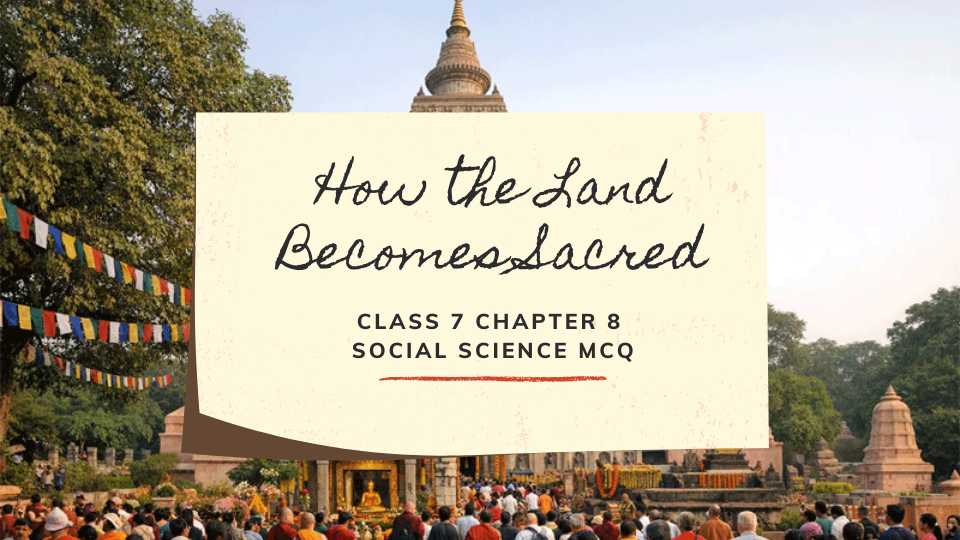
Here is a quick look at what the social studies chapter 8 covers:
- Meaning of sacredness: What makes a place, object, or journey sacred, and why it goes beyond just religion.
- Sacred places across religions: How Buddhism, Jainism, Sikhism, Islam, Christianity, and Hinduism each have their own network of holy sites across India.
- Tirthayatra – the pilgrimage tradition: Indians have been undertaking pilgrimages for at least 3,000 years, covering the entire Subcontinent on foot.
- Char Dham and Jyotirlingas: The four Dhams placed at the four corners of India, and the 12 Jyotirlinga shrines dedicated to Shiva, forming a sacred map of the country.
- 51 Shakti Pithas: The legend behind these sites and how they spread across the entire Subcontinent, turning the land itself into the body of the divine mother.
- Kumbh Mela: Its origin was during amrita manthana. It occurs in four locations – Haridwar, Prayagraj, Nashik, and Ujjain.
- Kumbh Mela 2025: An estimated 660 million people participated in the 2025 Kumbh mela. This makes it one of the largest human gatherings in the world ever recorded.
- Sacred rivers: Rivers like the Ganga, Yamuna, Godavari, Narmada, and Kaveri is worshipped since Vedic times. It is also central to several rituals in daily life.
- Sacred ecology: Mountains, forests, trees, and rivers are seen as divine in many Indian traditions, not separate from human life but deeply connected to it.
- The Peepul tree: The tree is sacred in Hinduism, Buddhism, Sikhism, and Jainism. It is depicted on seals from Mohenjo-daro thousands of years ago.
- Sacred groves: Forests protected by communities across India because they are seen as the homes of deities, preserving biodiversity and water sources.
- Pandharpur Wari: An 800-year-old pilgrimage tradition in Maharashtra. In this devotees walk for 21 days to reach the Vithoba temple.
- Pilgrimage routes and trade: Ancient routes like the Uttarapatha and Dakshinapatha served both pilgrims and traders, helping goods and ideas travel across the country.
The chapter connects history, geography, culture, and environment in one. It helps students understand that the idea of a “sacred land” was never just about religion. It was a way of life that kept rivers clean, forests standing, and communities connected across thousands of kilometres. Understanding this tradition also makes students think about what we stand to lose if we ignore it today.
Test your understanding of this chapter with our MCQ questions for Class 7 Social Science.
Class 7 How the Land Becomes Sacred MCQ Questions with Answers
Class 7 SST Chapter 8 How the Land Becomes Sacred MCQ Questions
1. In the context of this chapter, sacredness refers mainly to something that is
a) expensive and rare
b) politically powerful
c) worthy of deep respect, reverence, and spiritual significance
d) useful only for trade
Answer:
c) worthy of deep respect, reverence, and spiritual significance
2. According to the chapter, sacredness may be connected not only with a place but also with
a) only a temple building
b) a journey, its route, and the land covered
c) only ancient kings
d) only religious books
Answer:
b) a journey, its route, and the land covered
3. A pilgrimage is best described as
a) a trade expedition to a foreign land
b) a journey to a sacred place significant within a religion or belief system
c) a military journey to protect borders
d) a visit to a capital city
Answer:
b) a journey to a sacred place significant within a religion or belief system
4. Bodh Gaya is especially important in Buddhism because it is believed to be the place where the Buddha
a) was born
b) wrote sacred texts
c) attained enlightenment
d) built a monastery
Answer:
c) attained enlightenment
5. The Great Stupa at Sanchi is described in the chapter as a
a) mountain shrine
b) relic stupa
c) sacred grove
d) temple tank
Answer:
b) relic stupa
6. In Sikhism, takhts are important because they are
a) trading ports
b) seats or centres of spiritual authority
c) military forts
d) agricultural settlements
Answer:
b) seats or centres of spiritual authority
7. The literal meaning of tirtha in the chapter is linked to
a) a place where one can cross a river or body of water
b) a place where kings were crowned
c) a school for monks
d) a market near a shrine
Answer:
a) a place where one can cross a river or body of water
8. Which statement best explains why the entire geography of India came to be seen as sacred?
a) Because all people lived in one city
b) Because pilgrimage networks crossed the subcontinent for thousands of years
c) Because only kings were allowed to travel
d) Because rivers were used only for irrigation
Answer:
b) Because pilgrimage networks crossed the subcontinent for thousands of years
9. In Jain tradition, tirthas are often associated with places where Tirthankaras
a) traded in valuable goods
b) attained liberation or experienced important events of their lives
c) built kingdoms
d) held military assemblies
Answer:
b) attained liberation or experienced important events of their lives
10. Sabarimala is used in the chapter as an example of
a) a coastal Buddhist centre
b) a hill shrine reached traditionally through a difficult trek
c) a sacred river confluence
d) a sacred grove in Meghalaya
Answer:
b) a hill shrine reached traditionally through a difficult trek
11. The chapter states that in many Hindu, tribal, and folk traditions, which of the following may be regarded as sacred?
a) Only temples and idols
b) Only rivers and mountains
c) Mountains, rivers, forests, trees, animals, and even stones
d) Only pilgrimage roads
Answer:
c) Mountains, rivers, forests, trees, animals, and even stones
12. The Niyam Dongar hill is sacred to which tribal community?
a) Todas
b) Bhils
c) Dongria Khond
d) Santhals
Answer:
c) Dongria Khond
13. The chapter presents the char dham as significant partly because the four sites are located in the
a) four corners of India
b) same mountain range
c) same river valley
d) deserts of western India only
Answer:
a) four corners of India
14. The story of the Shakti peethas symbolically suggests that
a) only one mountain is sacred
b) the whole land becomes the body of the divine mother
c) sacredness belongs only to rivers
d) pilgrimage should be avoided
Answer:
b) the whole land becomes the body of the divine mother
15. According to the chapter, pilgrimage routes helped cultural integration because travellers
a) avoided all contact with others
b) met people from different regions, languages, customs, and food traditions
c) travelled only within one kingdom
d) were forced to speak one language
Answer:
b) met people from different regions, languages, customs, and food traditions
16. Sacred ecology in the chapter refers to the idea that
a) nature should only be used for profit
b) natural landscapes are seen as sacred and therefore protected
c) forests should be cut near shrines
d) rivers have no role in spiritual life
Answer:
b) natural landscapes are seen as sacred and therefore protected
17. Prayagraj is especially important because it is located at the confluence of
a) Ganga, Yamuna, and the invisible Sarasvati
b) Ganga, Narmada, and Kaveri
c) Yamuna, Godavari, and Krishna
d) Sindhu, Ganga, and Brahmaputra
Answer:
a) Ganga, Yamuna, and the invisible Sarasvati
18. According to the legend in the chapter, the Kumbh Mela is held at Haridwar, Prayagraj, Nashik, and Ujjain because
a) these were capitals of ancient empires
b) drops of amrita are believed to have fallen there
c) all four are seaports
d) all four were built by the same ruler
Answer:
b) drops of amrita are believed to have fallen there
19. Sacred groves helped conserve nature because they were protected from activities such as
a) prayer and rituals
b) trade and travel
c) hunting, tree felling, and mining
d) storytelling and worship
Answer:
c) hunting, tree felling, and mining
20. Why did pilgrimage routes and trade routes often overlap in ancient India?
a) Because pilgrims and traders often needed the same roads and stopping points
b) Because traders were not allowed on normal roads
c) Because sacred places were all inside forests only
d) Because kings banned separate trade routes
Answer:
a) Because pilgrims and traders often needed the same roads and stopping points
How the Land Becomes Sacred Class 7 Assertion-Reason Questions
1. Assertion (A): Sacredness in India is connected not only with religion but also with geography. Reason (R): Sacredness may relate to a shrine, a pilgrimage journey, its route, and even the land covered.
a) Both A and R are true, and R is the correct explanation of A
b) Both A and R are true, but R is not the correct explanation of A
c) A is true, but R is false
d) A is false, but R is true
Answer:
a) Both A and R are true, and R is the correct explanation of A
2. Assertion (A): Pilgrimage networks played a role in the cultural integration of the Indian subcontinent. Reason (R): Travellers moving across regions encountered different languages, customs, foods, and ideas, while also noticing common cultural links.
a) Both A and R are true, and R is the correct explanation of A
b) Both A and R are true, but R is not the correct explanation of A
c) A is true, but R is false
d) A is false, but R is true
Answer:
a) Both A and R are true, and R is the correct explanation of A
3. Assertion (A): Sacred groves often preserve biodiversity and water sources. Reason (R): Many communities protected them from harmful activities because they were seen as the abodes of deities.
a) Both A and R are true, and R is the correct explanation of A
b) Both A and R are true, but R is not the correct explanation of A
c) A is true, but R is false
d) A is false, but R is true
Answer:
a) Both A and R are true, and R is the correct explanation of A
4. Assertion (A): The Kumbh Mela is connected with sacred geography. Reason (R): It is held at places where, according to legend, drops of amrita fell during the struggle over the nectar of immortality.
a) Both A and R are true, and R is the correct explanation of A
b) Both A and R are true, but R is not the correct explanation of A
c) A is true, but R is false
d) A is false, but R is true
Answer:
a) Both A and R are true, and R is the correct explanation of A
5. Assertion (A): Pilgrimage could also support economic life in ancient India. Reason (R): Pilgrims needed food and goods, so traders often travelled along the same routes and benefited from the movement of people.
a) Both A and R are true, and R is the correct explanation of A
b) Both A and R are true, but R is not the correct explanation of A
c) A is true, but R is false
d) A is false, but R is true
Answer:
a) Both A and R are true, and R is the correct explanation of A
How the Land Becomes Sacred Class 7 Fill in the blanks Questions
1. A journey to a sacred place is called a __________.
Answer:
pilgrimage
2. A sacred place where one symbolically crosses from ordinary life to higher spiritual life is called a __________.
Answer:
tirtha
3. The Great Stupa at __________ is an important Buddhist relic stupa.
Answer:
Sanchi
4. Bodh Gaya receives millions of visitors because it is associated with the Buddha’s __________.
Answer:
enlightenment
5. In Sikhism, important centres of spiritual authority are called __________.
Answer:
takhts
6. The four major sites of the Hindu pilgrimage network are called the __________ dham.
Answer:
char
7. A sacred confluence of rivers is called a __________.
Answer:
sangam
8. Prayagraj is known for the Kumbh Mela held at the confluence of Ganga, Yamuna, and invisible __________.
Answer:
Sarasvati
9. The peepul tree is botanically known as Ficus __________.
Answer:
religiosa
10. Sacred forests protected by communities are called sacred __________.
Answer:
groves
How the Land Becomes Sacred Class 7 True or False Questions
1. Sacredness in the chapter is limited only to man-made shrines.
Answer:
False
2. Followers of more than one faith may visit places such as the Dargah Sharif of Ajmer.
Answer:
True
3. The chapter says that pilgrimage is only a physical journey and has no inner meaning.
Answer:
False
4. Sabarimala is described as a hilltop shrine traditionally reached by a difficult trek.
Answer:
True
5. The chapter states that in many traditions, the whole Earth is considered sacred as Mother Earth or Bhudevi.
Answer:
True
6. The Niyam Dongar hill is sacred to the Todas of Tamil Nadu.
Answer:
False
7. Sacred geography helped connect distant regions of India through pilgrimage networks.
Answer:
True
8. The chapter says rivers have had no sacred role in India since Vedic times.
Answer:
False
9. Sacred groves often shelter biodiversity and help conserve water.
Answer:
True
10. The chapter suggests that many sacred places today face pollution and neglect.
Answer:
True
How the Land Becomes Sacred Class 7 Match the following Questions
Question 1
| Column A | Column B |
|---|---|
| 1. Bodh Gaya | A. Sacred hill shrine of Ayyappa |
| 2. Sanchi | B. Buddha attained enlightenment |
| 3. Sabarimala | C. Buddhist relic stupa |
| 4. Prayagraj | D. Confluence of sacred rivers and Kumbh Mela |
| 5. Peepul tree | E. Ficus religiosa |
Answer:
| Column A | Correct Answer |
|---|---|
| 1. Bodh Gaya | B. Buddha attained enlightenment |
| 2. Sanchi | C. Buddhist relic stupa |
| 3. Sabarimala | A. Sacred hill shrine of Ayyappa |
| 4. Prayagraj | D. Confluence of sacred rivers and Kumbh Mela |
| 5. Peepul tree | E. Ficus religiosa |
Question 2
| Column A | Column B |
|---|---|
| 1. Niyam Dongar | A. Sacred grove name in Meghalaya |
| 2. Dongria Khond | B. Sacred hill linked with Niyam Raja |
| 3. Khlaw kyntang | C. Community that reveres Niyam Dongar |
| 4. Uttarapatha | D. Major trade route across northern India |
| 5. Dakshinapatha | E. Southern trade route through Ujjain to Paithan |
Answer:
| Column A | Correct Answer |
|---|---|
| 1. Niyam Dongar | B. Sacred hill linked with Niyam Raja |
| 2. Dongria Khond | C. Community that reveres Niyam Dongar |
| 3. Khlaw kyntang | A. Sacred grove name in Meghalaya |
| 4. Uttarapatha | D. Major trade route across northern India |
| 5. Dakshinapatha | E. Southern trade route through Ujjain to Paithan |
Related Class 7 Social Science Chapters
Explore India’s culture and heritage further:
Next chapter: Chapter 9 – From the Rulers to the Ruled: Types of Governments
See all chapters: Class 7 Social Science MCQ – All Chapters
