
Every single day, without even thinking about it, you are part of a market. When your mother buys vegetables from the sabziwala, when you order something online, when a shopkeeper restocks his shelves — all of this is the market at work. It is all around us, and yet most of us never stop to ask how it actually works.
This page covers Chapter 12, Understanding Markets, from the textbook Exploring Society: India and Beyond, Grade 7 Part 1, under the unit Economic Life Around Us. It is part of the CBSE Class 7 Social Science curriculum based on the NCERT syllabus.
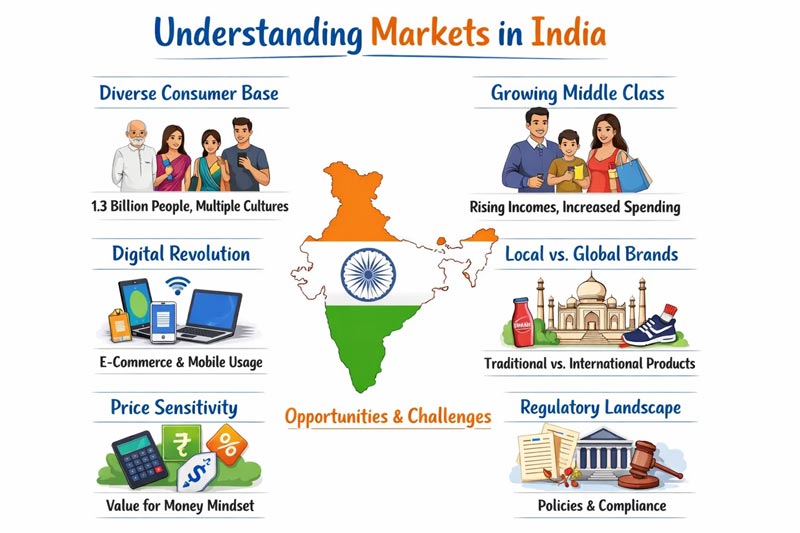
Below are some of the top topics covered in the chapter 12 of the social studies NCERT book:
- What is a market: A market is any place where buyers and sellers meet to exchange goods or services, physically or online.
- Hampi Bazaar, 16th century: The famous market in the Vijayanagara Empire was described by Portuguese traveller Domingos Paes as one of the richest trading centres in the world.
- Price and transactions: Every market transaction depends on a buyer and a seller both agreeing on a particular price. If there is no agreement, the transaction is void.
- Types of markets: Markets are either physical or online, domestic or international, and wholesale or retail. All these serve different purposes in the supply chain.
- Wholesale and retail: Wholesalers buy in bulk from producers and supply retailers, who then sell smaller quantities to final consumers like us.
- Surat textile market: Asia’s oldest textile market. Surat has been a major trading hub since the 16th century. It was known for both cotton textiles and the world’s largest diamond polishing industry, with 1.5 million artisans involved.
- Ima Keithal, Manipur: Literally meaning “Mother’s Market”. This unique market in Imphal is run entirely by around 3,000 women, providing income to thousands of families.
- Quality certification marks: Some of the top quality certification marks are – FSSAI (food products), ISI mark (electrical and industrial goods), AGMARK (agricultural products), and BEE Star ratings (energy efficiency of appliances). It helps to assess product quality
This chapter connects directly to everyday life. Understanding how markets work helps students become smarter consumers. It also lays the foundation for topics such as trade, government policy, and economic development that students will study in higher classes. A chapter like this, taught well, can change how a young person looks at a trip to the local market or an online shopping app. That is the real value of studying it carefully.
Test how well you have understood the topic with these MCQ questions for Class 7 Social Science.
Class 7 Understanding Markets MCQ Questions with Answers
Class 7 SST Chapter 12 Understanding Markets MCQ Questions
1. What is a market?
a) A place where only vegetables are sold
b) A place or system where buyers and sellers exchange goods and services
c) A place where only government offices work
d) A place where only money is stored
Answer:
b) A place or system where buyers and sellers exchange goods and services
2. Which of the following is an essential feature of a market?
a) Only a buyer is required
b) Only a seller is required
c) Buyers and sellers must agree on a price
d) Goods must always be sold online
Answer:
c) Buyers and sellers must agree on a price
3. In the chapter’s guava example, a transaction may not take place if
a) the seller has a cart
b) the buyer and seller do not reach a mutually agreeable price
c) the market is crowded
d) the buyer has a shopping bag
Answer:
b) the buyer and seller do not reach a mutually agreeable price
4. If a seller fixes the price of guavas very high, what is most likely to happen?
a) More buyers will rush to buy them
b) Buyers may avoid buying them
c) The seller will always make more profit
d) The price will never change
Answer:
b) Buyers may avoid buying them
5. If the seller fixes the price of guavas very low, what is most likely to happen?
a) Buyers may buy quickly but the seller may lose profit
b) No one will buy them
c) The market will close down
d) The product becomes illegal
Answer:
a) Buyers may buy quickly but the seller may lose profit
6. Over time, the price of a good in a market is mainly influenced by
a) the colour of the goods
b) demand from buyers and supply by sellers
c) only the wishes of the seller
d) only the wishes of the buyer
Answer:
b) demand from buyers and supply by sellers
7. Which type of market requires buyers and sellers to meet physically?
a) Online market
b) International market
c) Physical market
d) Stock market only
Answer:
c) Physical market
8. Which of the following is an example of an online market?
a) Weekly haat only
b) A shopping app or website used to buy goods
c) A mandi for grains
d) A roadside vegetable cart
Answer:
b) A shopping app or website used to buy goods
9. A market where goods and services are bought and sold within a country is called a
a) foreign market
b) domestic market
c) stock market
d) digital market
Answer:
b) domestic market
10. When goods produced in one country are sold to buyers in another country, it is called
a) import
b) domestic trade
c) export
d) retailing
Answer:
c) export
11. India was the world’s largest importer of vegetable oils in 2024 according to the chapter’s note. Which of the following was one such imported oil?
a) Mustard oil only
b) Palm oil
c) Coconut oil only
d) Castor oil only
Answer:
b) Palm oil
12. In physical markets, wholesalers generally buy goods
a) in very small quantities from retailers
b) in large quantities from producers or manufacturers
c) only from final consumers
d) only from foreign countries
Answer:
b) in large quantities from producers or manufacturers
13. Goods bought by wholesalers are often stored in large warehouses called
a) kiosks
b) depots
c) godowns
d) cabins
Answer:
c) godowns
14. What is the main role of a retailer?
a) To buy in bulk directly from all farmers
b) To sell goods in smaller quantities to final consumers
c) To regulate markets for the government
d) To certify the quality of products
Answer:
b) To sell goods in smaller quantities to final consumers
15. Distributors are needed in some markets mainly because
a) retailers refuse to sell goods
b) wholesalers cannot always reach many retailers across distances and terrains
c) producers do not want profits
d) consumers only buy imported goods
Answer:
b) wholesalers cannot always reach many retailers across distances and terrains
16. In online markets, businesses that combine offers from multiple sellers and sell them through a website or app are called
a) retailers
b) brokers
c) aggregators
d) exporters
Answer:
c) aggregators
17. Which city is highlighted in the chapter as a major textile hub and one of Asia’s oldest textile markets?
a) Jaipur
b) Surat
c) Imphal
d) Hampi
Answer:
b) Surat
18. Which unique market in Imphal is run entirely by women?
a) Johari Bazaar
b) Khari Baoli
c) Ima Keithal
d) Hampi Bazaar
Answer:
c) Ima Keithal
19. According to the chapter, the government may set a minimum price for crops like wheat and paddy mainly to
a) reduce farming completely
b) ensure that farmers do not incur losses
c) stop markets from functioning
d) increase imports
Answer:
b) ensure that farmers do not incur losses
20. Which government certification mark on food packets shows that the food has been tested and is safe to consume?
a) ISI
b) AGMARK
c) FSSAI
d) BEE
Answer:
c) FSSAI
21. Which mark is generally found on electrical appliances and helps ensure quality and safety?
a) AGMARK
b) ISI
c) FSSAI
d) QR mark
Answer:
b) ISI
22. The BEE Star rating on appliances helps consumers mainly by showing
a) the colour options available
b) the energy efficiency of the appliance
c) the number of shops selling it
d) whether bargaining is allowed
Answer:
b) the energy efficiency of the appliance
Understanding Markets Class 7 Assertion-Reason Questions
1. Assertion (A): Price is an important feature in completing a market transaction. Reason (R): A transaction usually takes place only when the buyer and seller agree on a price.
a) Both A and R are true, and R is the correct explanation of A
b) Both A and R are true, but R is not the correct explanation of A
c) A is true, but R is false
d) A is false, but R is true
Answer:
a) Both A and R are true, and R is the correct explanation of A
2. Assertion (A): The final price of a good in a market is influenced by demand and supply. Reason (R): Sellers observe how much buyers want, and buyers respond to the price offered by sellers.
a) Both A and R are true, and R is the correct explanation of A
b) Both A and R are true, but R is not the correct explanation of A
c) A is true, but R is false
d) A is false, but R is true
Answer:
a) Both A and R are true, and R is the correct explanation of A
3. Assertion (A): Retailers and wholesalers play different roles in markets. Reason (R): Wholesalers buy in bulk from producers, while retailers sell in smaller quantities to final consumers.
a) Both A and R are true, and R is the correct explanation of A
b) Both A and R are true, but R is not the correct explanation of A
c) A is true, but R is false
d) A is false, but R is true
Answer:
a) Both A and R are true, and R is the correct explanation of A
4. Assertion (A): The government intervenes in markets in some situations. Reason (R): It may regulate prices, maintain quality and safety standards, and protect consumers and producers from unfair outcomes.
a) Both A and R are true, and R is the correct explanation of A
b) Both A and R are true, but R is not the correct explanation of A
c) A is true, but R is false
d) A is false, but R is true
Answer:
a) Both A and R are true, and R is the correct explanation of A
5. Assertion (A): Certification marks help consumers assess product quality. Reason (R): Marks such as FSSAI, ISI, AGMARK, and BEE indicate that products meet certain standards or provide useful quality information.
a) Both A and R are true, and R is the correct explanation of A
b) Both A and R are true, but R is not the correct explanation of A
c) A is true, but R is false
d) A is false, but R is true
Answer:
a) Both A and R are true, and R is the correct explanation of A
Understanding Markets Class 7 Fill in the blanks Questions
1. A place where people buy and sell goods is called a __________.
Answer:
market
2. The amount at which a buyer is willing to buy and a seller is willing to sell is called the __________.
Answer:
price
3. A market where buyers and sellers meet through websites or apps is called an __________ market.
Answer:
online
4. Goods brought into a country from another country are called __________.
Answer:
imports
5. Goods sold from one country to buyers in another country are called __________.
Answer:
exports
6. Wholesalers often store goods in large warehouses called __________.
Answer:
godowns
7. Retailers sell goods to final __________.
Answer:
consumers
8. Websites or apps that combine offers from many sellers are called __________.
Answer:
aggregators
9. The government may set a minimum price for crops so that farmers do not incur __________.
Answer:
losses
10. The BEE Star label helps consumers compare the __________ efficiency of appliances.
Answer:
energy
Understanding Markets Class 7 True or False Questions
1. Markets can exist only at physical places and not online.
Answer:
False
2. A market needs both buyers and sellers.
Answer:
True
3. Domestic markets involve buying and selling within a country’s boundaries.
Answer:
True
4. Retailers usually buy goods in small quantities and sell them in bulk to producers.
Answer:
False
5. Distributors may help bridge the gap between wholesalers and retailers.
Answer:
True
6. Surat is described in the chapter as a major textile hub.
Answer:
True
7. Ima Keithal in Imphal is run only by men.
Answer:
False
8. The government may regulate prices of certain essential goods and services.
Answer:
True
9. AGMARK is a certification mark for agricultural products.
Answer:
True
10. Online reviews and feedback can help consumers decide whether to buy a product.
Answer:
True
Understanding Markets Class 7 Match the following Questions
Question 1
| Column A | Column B |
|---|---|
| 1. Physical market | A. Buyers and sellers transact through apps or websites |
| 2. Online market | B. Buyers and sellers meet physically |
| 3. Domestic market | C. Trade within the country’s boundaries |
| 4. International market | D. Trade across national borders |
| 5. Retail market | E. Sells to final consumers |
Answer:
| Column A | Correct Answer |
|---|---|
| 1. Physical market | B. Buyers and sellers meet physically |
| 2. Online market | A. Buyers and sellers transact through apps or websites |
| 3. Domestic market | C. Trade within the country’s boundaries |
| 4. International market | D. Trade across national borders |
| 5. Retail market | E. Sells to final consumers |
Question 2
| Column A | Column B |
|---|---|
| 1. Wholesaler | A. Sells in smaller quantities to final consumers |
| 2. Retailer | B. Buys in large quantities from producer or manufacturer |
| 3. FSSAI | C. Certification mark for food safety |
| 4. ISI | D. Mark for quality and safety on many manufactured goods |
| 5. BEE Star rating | E. Shows energy efficiency of appliances |
Answer:
| Column A | Correct Answer |
|---|---|
| 1. Wholesaler | B. Buys in large quantities from producer or manufacturer |
| 2. Retailer | A. Sells in smaller quantities to final consumers |
| 3. FSSAI | C. Certification mark for food safety |
| 4. ISI | D. Mark for quality and safety on many manufactured goods |
| 5. BEE Star rating | E. Shows energy efficiency of appliances |
Related Class 7 Economics Chapters
Understand money, markets and finance with these chapters:
- From Barter to Money MCQs
- Infrastructure: Engine of India’s Development MCQs
- Banks and the Magic of Finance MCQs
Next chapter: Part 2, Chapter 1 – The Story of Indian Farming
See all chapters: Class 7 Social Science MCQ – All Chapters
