
Right now, you probably have a few rupees in your pocket or a phone that can pay for things with a tap. But have you ever wondered how people bought and sold things before any of that existed? The answer goes back thousands of years, and it is a lot more interesting than you might expect.
Chapter 11, From Barter to Money, is part of the unit Economic Life Around Us from the textbook Exploring Society: India and Beyond, Grade 7 Part 1, under the CBSE curriculum. It traces the full journey from humans swapping goods directly to the digital payments we use today, and explains why each change occurred.
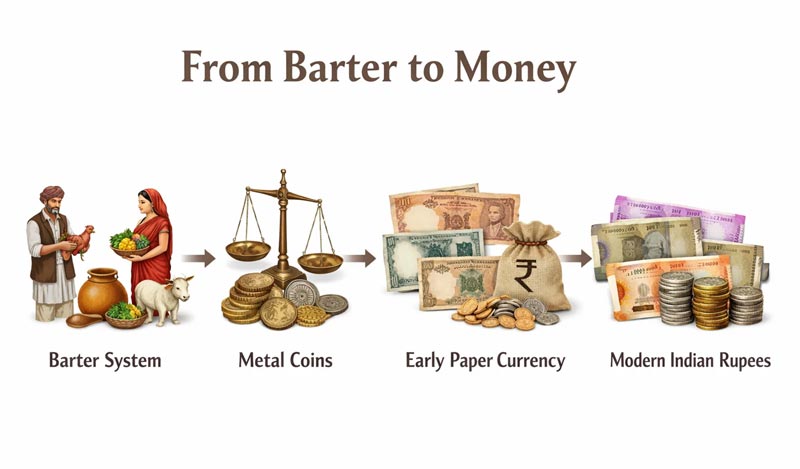
Take a look at what this chapter covers:
- The barter system: The oldest form of exchange, where goods and services were traded directly for other goods and services, without using money.
- Commodities used as money: Before coins, people used cowrie shells, salt, tea, cloth, cattle, seeds, and tobacco as mediums of exchange.
- Double coincidence of wants: A major problem with barter, is that both parties had to want exactly what the other is offering at the same time.
- No common standard measure of value: Under barter, there was no agreed way to compare the worth of different goods, making fair exchange very difficult.
- Divisibility problem: You cannot cut up an ox to pay for a sweater. Barter failed when the item being traded could not be split into smaller portions.
- Portability problem: Carrying large or heavy goods like bags of wheat everywhere for trade was impractical and tiring.
- Durability problem: Goods like grain would rot or get eaten by pests, so they could not be stored for future use as payment.
- Functions of money: Money acts as a medium of exchange, a store of value, a common denomination to measure worth, and a standard of deferred payment.
- Junbeel Mela, Assam: A three-day annual fair at Junbeel in Morigaon district, Assam, where tribal communities from Assam and Meghalaya have been practising barter since the 15th century.
- Evolution of money in India (timeline): It all started with barter around 6000 BCE, cowrie shells around 1000 BCE, metal coinage around 600 BCE, official paper money in 1861, digital cards from 1980, and UPI from 2016.
- Ancient Indian coins: Called karshapaṇas or paṇas, made from gold, silver, or copper alloys, with symbols called rupas punched on them.
- The word ‘paṇa’ lives on: Variations of this ancient word still exist today as paṇam in Tamil, Telugu, and Malayalam, and haṇa in Kannada.
- Chalukya coins: Featured the Varaha avatar of Vishnu on one side and a three-tiered royal parasol on the other.
- Roman gold coins in India: Roman coins with kings’ faces were excavated in Pudukkottai, Tamil Nadu, showing that ancient southern India had active maritime trade with Rome.
- The rupee symbol (Rs.): The Rs. sign was adopted by the Government of India in 2010, designed by Udaya Kumar of IIT Bombay. It blends the Devanagari “Ra” and Roman “R”.
- Paper money in India: Paper currency was first used in China and was introduced in India in the late 18th century.
- Reserve Bank of India (RBI): RBI is the legal authority that issues currency in India.
- Digital money today: Debit cards, credit cards, net banking, and UPI (Unified Payments Interface) allow money to be transferred directly between bank accounts without physical cash.
Money is more than something you use to buy things. It is one of the most important inventions in human history. Every time you pay for something at a shop, tap your phone to a QR code, or receive pocket money, you are part of a system that took thousands of years to build. Understanding where it came from and how it works helps students make sense of the economy around them every day.
Ready to test what you have learnt? Try our MCQ questions for Class 7 Social Science on this chapter.
Class 7 From Barter to Money MCQ Questions with Answers
Class 7 SST Chapter 11 From Barter to Money MCQ Questions
1. In the barter system, people exchange
a) only coins for goods
b) goods and services for other goods and services
c) only paper notes for services
d) gold for silver only
Answer:
b) goods and services for other goods and services
2. Which of the following is the earliest form of exchange discussed in the chapter?
a) Digital payment
b) Bank transfer
c) Barter system
d) Paper currency
Answer:
c) Barter system
3. Which of the following was used as a commodity for exchange in different parts of the world?
a) Plastic cards
b) Cowrie shells
c) Mobile phones
d) Printed bills
Answer:
b) Cowrie shells
4. The main problem in barter where two people must each want what the other has is called
a) portability
b) divisibility
c) double coincidence of wants
d) durability
Answer:
c) double coincidence of wants
5. In the farmer example, why was exchanging one ox directly for a pair of shoes difficult?
a) Shoes could not be traded
b) It was not a fair exchange in value
c) Oxen had no value
d) Farmers were not allowed to trade
Answer:
b) It was not a fair exchange in value
6. Which limitation of barter is shown by the difficulty of comparing the worth of one good with another?
a) Lack of a common standard measure of value
b) Lack of roads
c) Lack of transport
d) Lack of markets
Answer:
a) Lack of a common standard measure of value
7. Which problem of barter is shown by the statement that you cannot exchange only a part of an ox for a sweater?
a) Durability
b) Divisibility
c) Coinage
d) Deferred payment
Answer:
b) Divisibility
8. Which problem of barter is shown when carrying the ox everywhere becomes difficult?
a) Portability
b) Denomination
c) Coinage
d) Motif
Answer:
a) Portability
9. Which problem of barter is shown when wheat may rot or get eaten by rats?
a) Divisibility
b) Durability
c) Portability
d) Exchange rate
Answer:
b) Durability
10. Money came into existence mainly because people needed a
a) stronger king
b) common medium of exchange
c) larger army
d) separate market for farmers
Answer:
b) common medium of exchange
11. Which of the following is a basic function of money mentioned in the chapter?
a) It acts as a medium of exchange
b) It removes the need for trade
c) It makes all goods free
d) It replaces production
Answer:
a) It acts as a medium of exchange
12. Money serves as a standard of deferred payment because
a) it can never be saved
b) it allows payments to be made later
c) it can be used only for loans
d) it is accepted only by banks
Answer:
b) it allows payments to be made later
13. Money acts as a store of value because it
a) can be used to decorate coins
b) can be kept and used later for purchases
c) always increases in amount automatically
d) can be eaten when needed
Answer:
b) can be kept and used later for purchases
14. Money serves as a common denomination because it
a) helps compare the value of goods and services in prices
b) removes the need for markets
c) fixes the same price for all goods
d) makes barter easier
Answer:
a) helps compare the value of goods and services in prices
15. According to the timeline in the chapter, one of the earliest forms of money after barter was
a) debit cards
b) paper money
c) cowrie
d) QR codes
Answer:
c) cowrie
16. Ancient rulers controlled the minting and issue of
a) paper notes only
b) coins
c) QR codes
d) debit cards
Answer:
b) coins
17. Ancient Indian coins made of precious metals were called
a) rupayas only
b) karshapanas or panas
c) dinars only
d) tankas only
Answer:
b) karshapanas or panas
18. The symbols punched on ancient coins were called
a) mudras
b) rupas
c) denaris
d) lekhas
Answer:
b) rupas
19. Paper money was first used in
a) India
b) Rome
c) China
d) Arabia
Answer:
c) China
20. In India today, the authority that controls the issue of currency is the
a) Election Commission
b) Reserve Bank of India
c) Ministry of Trade
d) Supreme Court
Answer:
b) Reserve Bank of India
21. Which of the following is an intangible form of money mentioned in the chapter?
a) Copper coin
b) Paper note
c) Digital money
d) Cowrie shell
Answer:
c) Digital money
From Barter to Money Class 7 Assertion-Reason Questions
1. Assertion (A): The barter system created many practical difficulties in daily life. Reason (R): People had to find someone who wanted exactly what they offered and also had exactly what they needed.
a) Both A and R are true, and R is the correct explanation of A
b) Both A and R are true, but R is not the correct explanation of A
c) A is true, but R is false
d) A is false, but R is true
Answer:
a) Both A and R are true, and R is the correct explanation of A
2. Assertion (A): Wheat was not an ideal item for long-term exchange in the farmer example. Reason (R): Wheat could spoil or get eaten by rats, showing the problem of durability.
a) Both A and R are true, and R is the correct explanation of A
b) Both A and R are true, but R is not the correct explanation of A
c) A is true, but R is false
d) A is false, but R is true
Answer:
a) Both A and R are true, and R is the correct explanation of A
3. Assertion (A): Money became accepted as a common medium of exchange. Reason (R): It made buying and selling goods and services easier than barter.
a) Both A and R are true, and R is the correct explanation of A
b) Both A and R are true, but R is not the correct explanation of A
c) A is true, but R is false
d) A is false, but R is true
Answer:
a) Both A and R are true, and R is the correct explanation of A
4. Assertion (A): Coins helped facilitate trade across geographies. Reason (R): Coins of powerful rulers came to be accepted beyond their own kingdoms.
a) Both A and R are true, and R is the correct explanation of A
b) Both A and R are true, but R is not the correct explanation of A
c) A is true, but R is false
d) A is false, but R is true
Answer:
a) Both A and R are true, and R is the correct explanation of A
5. Assertion (A): Digital money is now widely used in everyday transactions. Reason (R): Methods such as UPI, debit cards, credit cards, and net banking transfer money electronically between bank accounts.
a) Both A and R are true, and R is the correct explanation of A
b) Both A and R are true, but R is not the correct explanation of A
c) A is true, but R is false
d) A is false, but R is true
Answer:
a) Both A and R are true, and R is the correct explanation of A
From Barter to Money Class 7 Fill in the blanks Questions
1. The earliest form of exchange without using money is called the __________ system.
Answer:
barter
2. The situation in which two people each have something the other wants is called double coincidence of __________.
Answer:
wants
3. The ability of an object to be split into smaller parts is called __________.
Answer:
divisibility
4. The ability of an object to be carried from one place to another is called __________.
Answer:
portability
5. The trait that allows an item to last for a longer period without damage is called __________.
Answer:
durability
6. Money acts as a common medium of __________.
Answer:
exchange
7. Money can be kept for future use because it acts as a store of __________.
Answer:
value
8. The process of producing coins is called __________.
Answer:
minting
9. Paper money in India is controlled by the Reserve Bank of __________.
Answer:
India
10. UPI stands for Unified Payments __________.
Answer:
Interface
From Barter to Money Class 7 True or False Questions
1. In a barter system, people exchange goods and services without using money.
Answer:
True
2. The barter system always makes exchange easy and fair in every situation.
Answer:
False
3. Divisibility is a problem when an item cannot be split conveniently for exchange.
Answer:
True
4. Wheat in the farmer example could be stored forever without any loss.
Answer:
False
5. Money can be used as a standard of deferred payment.
Answer:
True
6. Ancient coins were always made only of plastic-like materials.
Answer:
False
7. Paper currency was introduced in India in the late 18th century.
Answer:
True
8. It is legal for anybody in India to issue currency notes.
Answer:
False
9. Digital money is an intangible form of money.
Answer:
True
10. A QR code can be used for receiving digital payments.
Answer:
True
From Barter to Money Class 7 Match the following Questions
Question 1
| Column A | Column B |
|---|---|
| 1. Double coincidence of wants | A. Ability to last long without damage |
| 2. Divisibility | B. Two people each want what the other has |
| 3. Portability | C. Ability to split into smaller parts |
| 4. Durability | D. Ability to be carried easily |
| 5. Common standard measure of value | E. Agreed worth for comparing goods and services |
Answer:
| Column A | Correct Answer |
|---|---|
| 1. Double coincidence of wants | B. Two people each want what the other has |
| 2. Divisibility | C. Ability to split into smaller parts |
| 3. Portability | D. Ability to be carried easily |
| 4. Durability | A. Ability to last long without damage |
| 5. Common standard measure of value | E. Agreed worth for comparing goods and services |
Question 2
| Column A | Column B |
|---|---|
| 1. Cowrie | A. Controls issue of currency in India |
| 2. Karshapanas or panas | B. Early form of commodity money |
| 3. RBI | C. Ancient coins |
| 4. UPI | D. Digital payment system |
| 5. QR code | E. Quick-response code used for payment details |
Answer:
| Column A | Correct Answer |
|---|---|
| 1. Cowrie | B. Early form of commodity money |
| 2. Karshapanas or panas | C. Ancient coins |
| 3. RBI | A. Controls issue of currency in India |
| 4. UPI | D. Digital payment system |
| 5. QR code | E. Quick-response code used for payment details |
Related Class 7 Economics Chapters
Understand money, markets and finance with these chapters:
- Understanding Markets MCQs
- Infrastructure: Engine of India’s Development MCQs
- Banks and the Magic of Finance MCQs
Next chapter: Chapter 12 – Understanding Markets
See all chapters: Class 7 Social Science MCQ – All Chapters
