
Who decides the rules you live by? Who makes sure those rules are followed? And what happens when the people in charge stop caring about the people they govern? These questions have shaped how societies have organised themselves for thousands of years.
Chapter 9, From the Rulers to the Ruled: Types of Governments, is part of the unit Governance and Democracy from the textbook Exploring Society: India and Beyond, Grade 7 Part 1, under the CBSE curriculum. It walks students through the different ways countries are governed, how power is shared or held back, and why the form of government a country has matters deeply to its people.
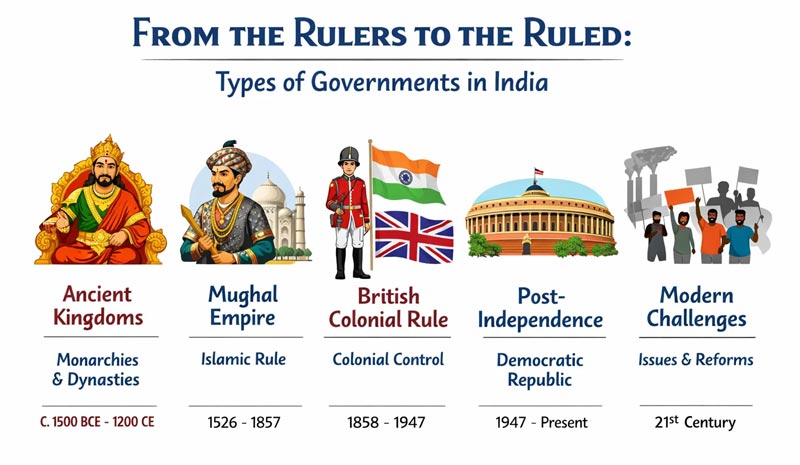
Take a look at social science chapter 9 from NCERT book covers:
- What government does: Governments maintain law and order, manage defence, deliver services, and work for people’s welfare.
- Three functions of government: The 3 functions of government are – making laws (legislative), putting them into action (executive), and ensuring they are followed (judicial).
- What democracy means: Democracy means rule of the people. Citizens choose their representatives through elections.
- Core principles of democracy: Equality before law, freedom of expression, universal adult franchise, fundamental rights, and an independent judiciary.
- India’s universal adult franchise: India gave all adults the right to vote from 1950, the very start of the republic.
- Women’s right to vote in Switzerland: Switzerland granted women the right to vote only in 1971, long after many other countries.
- When democracies were established: USA in 1787, Switzerland in 1848, India in 1947, Germany in 1949, Kenya in 1964 and Nepal in 2008.
- Direct democracy: In this type of democracy every citizen participates in decisions directly. Switzerland practices some elements of this today.
- Representative democracy: Citizens elect representatives to govern on their behalf. Most modern democracies follow this model.
- Parliamentary vs presidential democracy: In parliamentary systems like India, the executive is part of the legislature. In presidential systems like the USA, they work separately.
- India’s Parliament: The Lok Sabha is the lower house and is more powerful than the Rajya Sabha, the upper house.
- Early republics in India: The Vajji mahajanapada, led by the Lichchhavi clan, practised collective decision-making with leaders chosen by merit, not birth.
- Uttaramerur inscriptions, 10th century CE: These Chola-period inscriptions from Tamil Nadu describe a detailed local election system, including sealed ballot boxes and rules for dismissing corrupt members.
- Monarchy – two types: Absolute monarchy gives the ruler complete power (example: Saudi Arabia). Constitutional monarchy limits the ruler’s power by law (example: United Kingdom).
- Theocracy: Government ruled by religious law and leaders. Iran and Vatican City are examples.
- Dictatorship: One person or group holds total power with no legal limits. Adolf Hitler became dictator of Germany in 1933. World War II lasted from 1939 to 1945 and was largely caused by his actions.
- The Holocaust: Hitler’s regime was responsible for killing at least six million Jews, along with hundreds of thousands of Roma and others.
- Oligarchy: A small, powerful group controls all major decisions. Ancient Greece had oligarchies run by aristocratic families.
- Challenges within democracy: Top ones include corruption, wealth inequality, and control of information. All these can weaken democracy even where elections are held.
This chapter matters because the type of government a country has affects every part of daily life. Whether you can speak freely, vote for your leaders, or even choose what to wear depends on who holds power and how. Understanding the differences among democracy, monarchy, dictatorship, and other systems equips students to think critically about the world around them and to appreciate what a functioning democracy offers its people.
Sharpen your understanding of this chapter with our MCQ questions for Class 7 Social Science.
Class 7 From the Rulers to the Ruled Types of Governments MCQ Questions with Answers
Class 7 SST Chapter 9 From the Rulers to the Ruled Types of Governments MCQ Questions
1. Which of the following is one of the important roles of government mentioned in the chapter?
a) Only organizing sports festivals
b) Maintaining law and order in society
c) Choosing school uniforms
d) Running private businesses only
Answer:
b) Maintaining law and order in society
2. In a democracy, the ultimate source of power and authority is
a) the king
b) the military
c) the people
d) religious leaders
Answer:
c) the people
3. In the school example, which option was considered the democratic way to form the student committee?
a) The Head Teacher chooses all members
b) Only senior students become members
c) Students elect representatives through voting
d) Every student becomes part of the committee
Answer:
c) Students elect representatives through voting
4. A person chosen to act or make decisions on behalf of others is called a
a) minister
b) judge
c) representative
d) monarch
Answer:
c) representative
5. The function of making laws is called the
a) executive function
b) judicial function
c) legislative function
d) electoral function
Answer:
c) legislative function
6. The implementation of laws and administration of the country is known as the
a) judicial function
b) executive function
c) legislative function
d) constitutional function
Answer:
b) executive function
7. Ensuring that rules are followed is the responsibility of the
a) judicial function
b) revenue function
c) ceremonial function
d) military function
Answer:
a) judicial function
8. Abraham Lincoln described democracy as a government
a) of the king, by the king, for the king
b) of the people, by the people, for the people
c) of ministers, by judges, for officers
d) of the rich, by the powerful, for the elite
Answer:
b) of the people, by the people, for the people
9. Which of the following is not one of the four major aspects used in the chapter to compare governments?
a) Who gives the government authority
b) How the government is formed
c) What food citizens eat daily
d) What the government is working for
Answer:
c) What food citizens eat daily
10. Equality in a democracy means that every person
a) must have the same job
b) has the right to be treated equally
c) must support the same political party
d) should live in the same way
Answer:
b) has the right to be treated equally
11. Freedom in a democracy mainly means that citizens have the right to
a) rule without laws
b) make their own choices and express their opinions
c) ignore the constitution
d) punish others
Answer:
b) make their own choices and express their opinions
12. Universal adult franchise means
a) only landowners can vote
b) only educated adults can vote
c) every adult citizen above a certain age has the right to vote
d) only men can vote
Answer:
c) every adult citizen above a certain age has the right to vote
13. Which country is mentioned as giving women the right to vote only in 1971?
a) India
b) Nepal
c) Switzerland
d) Germany
Answer:
c) Switzerland
14. Direct democracy is difficult to practise mainly because
a) people dislike voting
b) it is hard for all citizens to participate directly in every decision, especially in large countries
c) it requires kings and queens
d) it does not allow discussions
Answer:
b) it is hard for all citizens to participate directly in every decision, especially in large countries
15. India is an example of
a) direct democracy
b) representative democracy
c) absolute monarchy
d) dictatorship
Answer:
b) representative democracy
16. In a parliamentary democracy like India, the executive is
a) completely separate from the legislature in membership
b) chosen only by judges
c) formed from members of the legislature
d) hereditary
Answer:
c) formed from members of the legislature
17. In a presidential democracy, the president
a) must always be a member of parliament
b) works independently of the legislature
c) is appointed by a monarch
d) can rule only for one month
Answer:
b) works independently of the legislature
18. In India, the Lower House of Parliament is called the
a) Rajya Sabha
b) Senate
c) Lok Sabha
d) National Assembly
Answer:
c) Lok Sabha
19. Separation of powers means that the legislature, executive, and judiciary
a) are controlled by one person
b) work independently and do not interfere in one another’s functions
c) are all part of the military
d) make the same decisions together
Answer:
b) work independently and do not interfere in one another’s functions
20. A republic is a form of government in which the head of state is
a) always a hereditary monarch
b) elected and not hereditary
c) chosen by religious priests only
d) always selected by foreign powers
Answer:
b) elected and not hereditary
21. The Uttaramerur inscriptions are important because they provide details about
a) sea trade with Rome
b) village assembly elections in the Chola period
c) Mughal taxation
d) Gupta coin making
Answer:
b) village assembly elections in the Chola period
22. In an absolute monarchy, the monarch has
a) only ceremonial power
b) complete control over making laws, enforcing them, and judging disputes
c) no role in governance
d) power only during festivals
Answer:
b) complete control over making laws, enforcing them, and judging disputes
23. Which country is given in the chapter as an example of an absolute monarchy?
a) India
b) United Kingdom
c) Saudi Arabia
d) South Korea
Answer:
c) Saudi Arabia
24. A theocracy is a form of government where the country is ruled by
a) elected student committees
b) the rules of religion and religious leaders
c) business families only
d) military officers alone
Answer:
b) the rules of religion and religious leaders
25. Oligarchy is a system in which power is mainly held by
a) all citizens equally
b) one elected president alone
c) a small powerful group
d) village teachers
Answer:
c) a small powerful group
From the Rulers to the Ruled Types of Governments Class 7 Assertion-Reason Questions
1. Assertion (A): Democracy is called the rule of the people. Reason (R): In a democracy, the source of power and authority lies with the people of the country.
a) Both A and R are true, and R is the correct explanation of A
b) Both A and R are true, but R is not the correct explanation of A
c) A is true, but R is false
d) A is false, but R is true
Answer:
a) Both A and R are true, and R is the correct explanation of A
2. Assertion (A): Direct democracy is hard to implement in large countries. Reason (R): It is difficult for all citizens to directly participate in every decision and every function of government.
a) Both A and R are true, and R is the correct explanation of A
b) Both A and R are true, but R is not the correct explanation of A
c) A is true, but R is false
d) A is false, but R is true
Answer:
a) Both A and R are true, and R is the correct explanation of A
3. Assertion (A): In a parliamentary democracy, the executive is accountable to the legislature. Reason (R): The council of ministers continues to work only while it has the confidence of the legislature.
a) Both A and R are true, and R is the correct explanation of A
b) Both A and R are true, but R is not the correct explanation of A
c) A is true, but R is false
d) A is false, but R is true
Answer:
a) Both A and R are true, and R is the correct explanation of A
4. Assertion (A): Democracy is generally considered better than dictatorship, absolute monarchy, and oligarchy. Reason (R): Democracy provides universal adult franchise, protects rights, and allows people to change their representatives through elections.
a) Both A and R are true, and R is the correct explanation of A
b) Both A and R are true, but R is not the correct explanation of A
c) A is true, but R is false
d) A is false, but R is true
Answer:
a) Both A and R are true, and R is the correct explanation of A
5. Assertion (A): Even democracies can face serious problems. Reason (R): Corruption, wealth disparity, excessive control by a few, and erosion of judicial independence can create hurdles in achieving democratic ideals.
a) Both A and R are true, and R is the correct explanation of A
b) Both A and R are true, but R is not the correct explanation of A
c) A is true, but R is false
d) A is false, but R is true
Answer:
a) Both A and R are true, and R is the correct explanation of A
From the Rulers to the Ruled Types of Governments Class 7 Fill in the blanks Questions
1. Democracy is best understood as the rule of the __________.
Answer:
people
2. The making of laws is called the __________ function.
Answer:
legislative
3. The body responsible for implementing laws is called the __________.
Answer:
executive
4. In India, citizens elect their representatives through universal adult __________.
Answer:
franchise
5. In India, general elections are held every __________ years.
Answer:
five
6. In the USA, general elections are held every __________ years.
Answer:
four
7. In India, the Upper House of Parliament is called the __________ Sabha.
Answer:
Rajya
8. A form of government in which the head of state is elected and not hereditary is called a __________.
Answer:
republic
9. A government ruled by religion and religious leaders is called a __________.
Answer:
theocracy
10. A type of government in which a small powerful group controls decision-making is called an __________.
Answer:
oligarchy
From the Rulers to the Ruled Types of Governments Class 7 True or False Questions
1. In a democracy, the government is accountable to the people.
Answer:
True
2. In direct democracy, citizens choose representatives but do not participate in decisions directly.
Answer:
False
3. India is a parliamentary democracy.
Answer:
True
4. In a presidential democracy, the president always needs the confidence of the legislature to remain in office.
Answer:
False
5. Switzerland is mentioned in the chapter as an example where some forms of direct democracy are followed.
Answer:
True
6. In an absolute monarchy, the monarch has only symbolic power.
Answer:
False
7. The United Kingdom is described as a constitutional monarchy.
Answer:
True
8. Iran is described as having a system combining theocratic and democratic elements.
Answer:
True
9. Adolf Hitler is given in the chapter as an example of a dictator.
Answer:
True
10. According to the chapter, democracy has no problems or challenges at all.
Answer:
False
From the Rulers to the Ruled Types of Governments Class 7 Match the following Questions
Question 1
| Column A | Column B |
|---|---|
| 1. Legislative function | A. Implementing laws |
| 2. Executive function | B. Ensuring laws are followed |
| 3. Judicial function | C. Making laws |
| 4. Lok Sabha | D. Lower House in India |
| 5. Rajya Sabha | E. Upper House in India |
Answer:
| Column A | Correct Answer |
|---|---|
| 1. Legislative function | C. Making laws |
| 2. Executive function | A. Implementing laws |
| 3. Judicial function | B. Ensuring laws are followed |
| 4. Lok Sabha | D. Lower House in India |
| 5. Rajya Sabha | E. Upper House in India |
Question 2
| Column A | Column B |
|---|---|
| 1. Direct democracy | A. Government by a small powerful group |
| 2. Parliamentary democracy | B. Citizens directly participate in decisions |
| 3. Absolute monarchy | C. Executive formed from legislature |
| 4. Theocracy | D. Religion-based government |
| 5. Oligarchy | E. Monarch has complete control |
Answer:
| Column A | Correct Answer |
|---|---|
| 1. Direct democracy | B. Citizens directly participate in decisions |
| 2. Parliamentary democracy | C. Executive formed from legislature |
| 3. Absolute monarchy | E. Monarch has complete control |
| 4. Theocracy | D. Religion-based government |
| 5. Oligarchy | A. Government by a small powerful group |
Related Class 7 Civics Chapters
Learn how government and democracy work through these chapters:
Next chapter: Chapter 10 – The Constitution of India: An Introduction
See all chapters: Class 7 Social Science MCQ – All Chapters
