
What happens after a great civilisation falls? For nearly a thousand years after the decline of the Harappan civilisation, urban life had disappeared from India. Then, slowly, something remarkable began to take shape in the Ganga plains.
Chapter 4 of the Class 7 Social Science textbook Exploring Society: India and Beyond is going to deal with topics pertaining to New Beginnings: Cities and States. It is part of the Tapestry of the Past unit. The chapter will deal primarily with how India’s Second Urbanisation began. It also covers how early states were formed and how society organised itself during this transformative period.
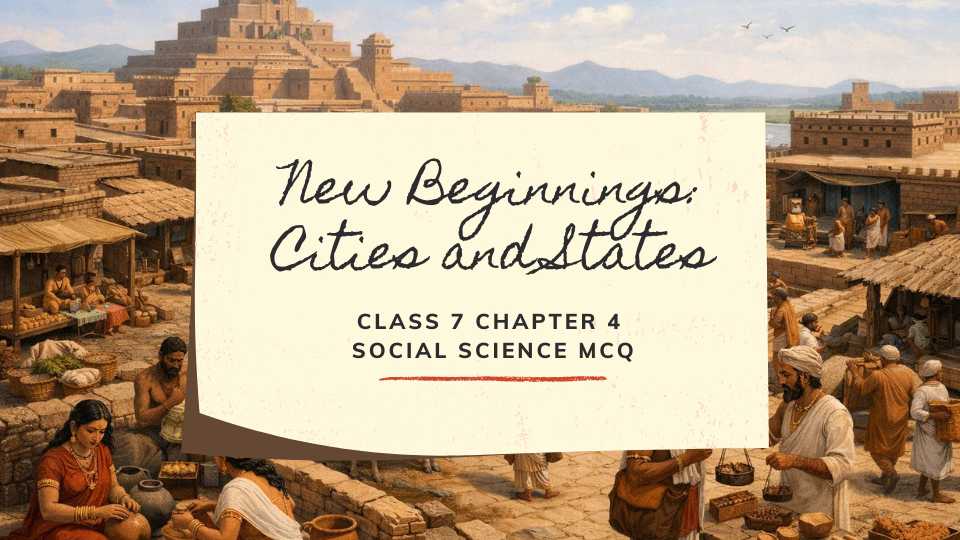
Here is a quick look at what chapter 4 of class 7 social studies covers:
- The gap after the First Urbanisation – how the Harappan civilisation declined around 2000 BCE and urban life disappeared for nearly a millennium
- Second Urbanisation – a vibrant new phase of city-building that began in the 1st millennium BCE in the Ganga plains
- Janapadas – clans settling into territories, each led by a raja, emerging towards the end of the 2nd millennium BCE
- The 16 Mahajanapadas – larger states formed by the 8th or 7th centuries BCE, stretching from Gandhara in the northwest to Ashmaka in central India
- Early Democratic Traditions – assemblies like sabha and samiti, and how some mahajanapadas like Vajji functioned as early republics
- Iron metallurgy – how iron tools transformed agriculture and warfare, fuelling the growth of cities and states
- First use of coins – punch-marked silver coins introduced to support expanding trade networks
- The Varna-Jati System – how Indian society organised itself into occupational and social groups, and how this system evolved over time
- Trade routes – the Uttarapatha and Dakshinapatha connecting north, south, east and west
- Southern kingdoms – the emergence of the Cholas, Cheras and Pandyas from around 400 BCE
The connection that the chapter draws between ancient India and the present is very interesting to follow. Many cities that served as mahajanapada capitals are still living cities today. It is surprising how these cities are thriving even 2,500 years later. The social structures, trade routes, and governance ideas from this period left a lasting mark on Indian civilisation.
We have put together a set of MCQ questions for Class 7 Social Science based on this chapter to help students revise and prepare effectively.
Class 7 New Beginnings Cities and States MCQ Questions with Answers
Class 7 SST Chapter 4 New Beginnings Cities and States MCQ Questions
1. What is meant by the “Second Urbanisation” of India?
a) The rebuilding of Harappan cities
b) A new phase of urban growth in the 1st millennium BCE
c) The rise of villages after the Harappan age
d) The growth of only coastal towns in south India
Answer:
b) A new phase of urban growth in the 1st millennium BCE
2. India’s “First Urbanisation” is associated with which civilisation?
a) Vedic Civilisation
b) Mauryan Civilisation
c) Harappan Civilisation
d) Gupta Civilisation
Answer:
c) Harappan Civilisation
3. Which two sources mainly help historians identify the new urban centres of the 1st millennium BCE?
a) Coins and paintings
b) Archaeological excavations and ancient literature
c) Temples and inscriptions only
d) Foreign travellers and maps
Answer:
b) Archaeological excavations and ancient literature
4. The word “janapada” roughly means
a) place where traders meet
b) land ruled by priests
c) where the people have set foot and settled
d) city with strong walls
Answer:
c) where the people have set foot and settled
5. By the 8th or 7th centuries BCE, some early states merged to form
a) nagaras
b) empires
c) mahājanapadas
d) republics only
Answer:
c) mahājanapadas
6. How many mahājanapadas are usually mentioned in the more frequent list found in texts?
a) 8
b) 12
c) 16
d) 18
Answer:
c) 16
7. Which of the following was one of the most powerful mahājanapadas?
a) Magadha
b) Kalinga
c) Satavahana
d) Pallava
Answer:
a) Magadha
8. Most capitals of the mahājanapadas were
a) small forest settlements
b) well-fortified cities
c) open grazing grounds
d) temporary military camps
Answer:
b) well-fortified cities
9. What was the purpose of a moat around a fortified city?
a) To grow crops near the capital
b) To store drinking water only
c) To provide extra defence
d) To connect the city to ports
Answer:
c) To provide extra defence
10. In early janapadas, important clan matters were discussed in the
a) monastery
b) sabhā or samiti
c) mint
d) battlefield
Answer:
b) sabhā or samiti
11. According to the chapter, a good ruler was expected to
a) rule completely independently
b) ignore elders and ministers
c) take advice from assemblies, ministers, and administrators
d) avoid taxes and armies
Answer:
c) take advice from assemblies, ministers, and administrators
12. Which mahājanapadas are mentioned as examples of early republics or gaṇas/sanghas?
a) Magadha and Kosala
b) Vajji and Malla
c) Anga and Vatsa
d) Avanti and Matsya
Answer:
b) Vajji and Malla
13. In some gaṇas or sanghas, the ruler could be selected through
a) war only
b) heredity only
c) discussion and vote in the assembly
d) foreign approval
Answer:
c) discussion and vote in the assembly
14. Which technological shift was especially important during the Second Urbanisation?
a) Discovery of steam power
b) Use of iron metallurgy
c) Invention of paper money
d) Construction of lighthouses
Answer:
b) Use of iron metallurgy
15. Iron tools helped agriculture mainly because they
a) were made of gold
b) were lighter and decorative
c) made farming on a larger scale easier
d) replaced all animal labour
Answer:
c) made farming on a larger scale easier
16. The first Indian coins mentioned in the chapter were mainly made of
a) iron
b) bronze
c) silver
d) clay
Answer:
c) silver
17. The earliest Indian coins are called punch-marked coins because
a) they were shaped like fists
b) symbols were punched into them
c) they were used only in battles
d) they were imported from abroad
Answer:
b) symbols were punched into them
18. In the varṇa system, Vaishyas were mainly expected to
a) preserve knowledge and perform rituals
b) defend the land and fight wars
c) increase wealth through trade, business, or agriculture
d) work only as ministers
Answer:
c) increase wealth through trade, business, or agriculture
19. Which route connected the northwest regions to the Ganga plains and further east?
a) Dakṣiṇapatha
b) Uttarapatha
c) Silk Route
d) Grand Trunk Route
Answer:
b) Uttarapatha
20. Around 400 BCE, which three kingdoms emerged in southern India according to the chapter?
a) Cholas, Cheras, and Pāṇḍyas
b) Cholas, Satavahanas, and Pallavas
c) Cheras, Guptas, and Mauryas
d) Pāṇḍyas, Kushanas, and Kurus
Answer:
a) Cholas, Cheras, and Pāṇḍyas
New Beginnings Cities and States Class 7 Assertion-Reason Questions
1. Assertion (A): The Second Urbanisation is considered a major phase in Indian history. Reason (R): It saw the rise of new cities, organised states, trade networks, and technological change.
a) Both A and R are true, and R is the correct explanation of A
b) Both A and R are true, but R is not the correct explanation of A
c) A is true, but R is false
d) A is false, but R is true
Answer:
a) Both A and R are true, and R is the correct explanation of A
2. Assertion (A): Most capitals of the mahājanapadas had strong fortifications. Reason (R): These cities needed protection and control over the movement of people and goods.
a) Both A and R are true, and R is the correct explanation of A
b) Both A and R are true, but R is not the correct explanation of A
c) A is true, but R is false
d) A is false, but R is true
Answer:
a) Both A and R are true, and R is the correct explanation of A
3. Assertion (A): Vajji and Malla were different from some other mahājanapadas. Reason (R): In them, assemblies had greater power and important decisions could be taken through discussion and voting.
a) Both A and R are true, and R is the correct explanation of A
b) Both A and R are true, but R is not the correct explanation of A
c) A is true, but R is false
d) A is false, but R is true
Answer:
a) Both A and R are true, and R is the correct explanation of A
4. Assertion (A): Iron metallurgy helped the growth of urbanism in the 1st millennium BCE. Reason (R): Iron tools improved agriculture and iron weapons strengthened warfare and expansion.
a) Both A and R are true, and R is the correct explanation of A
b) Both A and R are true, but R is not the correct explanation of A
c) A is true, but R is false
d) A is false, but R is true
Answer:
a) Both A and R are true, and R is the correct explanation of A
5. Assertion (A): By around 300 or 200 BCE, the Subcontinent had become highly interconnected. Reason (R): Roads, trade, and movement of goods and culture linked different regions of India.
a) Both A and R are true, and R is the correct explanation of A
b) Both A and R are true, but R is not the correct explanation of A
c) A is true, but R is false
d) A is false, but R is true
Answer:
a) Both A and R are true, and R is the correct explanation of A
New Beginnings Cities and States Class 7 Fill in the blanks Questions
1. India’s First Urbanisation is associated with the __________ civilisation.
Answer:
Harappan
2. The new phase of urban growth in the 1st millennium BCE is called the __________ Urbanisation.
Answer:
Second
3. A janapada was generally led by a __________.
Answer:
rājā
4. The larger states formed by the merging of janapadas were called __________.
Answer:
mahājanapadas
5. The assembly or council in early janapadas was called sabhā or __________.
Answer:
samiti
6. A deep wide ditch around a fort or fortified city is called a __________.
Answer:
moat
7. The first Indian coins were often made of __________.
Answer:
silver
8. Coins with symbols punched into them are known as __________-marked coins.
Answer:
punch
9. The route connecting the northwest to the Ganga plains was called the __________.
Answer:
Uttarapatha
10. The southern route starting from Kauśhāmbī and crossing the Vindhyas was called the __________.
Answer:
Dakṣiṇapatha
New Beginnings Cities and States Class 7 True or False Questions
1. The Harappan Civilisation is known as India’s Second Urbanisation.
Answer:
False
2. Ancient literature such as Buddhist and Jain texts mentions new urban centres.
Answer:
True
3. Every mahājanapada followed exactly the same political system.
Answer:
False
4. In some mahājanapadas, the assembly had the power to choose the ruler.
Answer:
True
5. Iron weapons were generally heavier and less effective than bronze according to the chapter.
Answer:
False
6. Growing trade led to the first use of coins in India.
Answer:
True
7. A jāti was always completely unrelated to occupation or livelihood.
Answer:
False
8. The chapter notes that the varṇa-jāti system was more flexible in earlier periods.
Answer:
True
9. Śhiśhupalgarh is mentioned as an important eastern city linked with the Kalinga region.
Answer:
True
10. By around 300 or 200 BCE, goods and culture travelled across much of the Subcontinent.
Answer:
True
New Beginnings Cities and States Class 7 Match the following Questions
Question 1
| Column A | Column B |
|---|---|
| 1. Janapada | A. Deep ditch around a fort |
| 2. Mahājanapada | B. Larger state formed by merger of smaller states |
| 3. Moat | C. Earliest silver coins with punched symbols |
| 4. Punch-marked coins | D. Territory where a clan or people had settled |
| 5. Sabhā or samiti | E. Assembly or council of elders |
Answer:
| Column A | Correct Answer |
|---|---|
| 1. Janapada | D. Territory where a clan or people had settled |
| 2. Mahājanapada | B. Larger state formed by merger of smaller states |
| 3. Moat | A. Deep ditch around a fort |
| 4. Punch-marked coins | C. Earliest silver coins with punched symbols |
| 5. Sabhā or samiti | E. Assembly or council of elders |
Question 2
| Column A | Column B |
|---|---|
| 1. Vajji and Malla | A. Route towards the south from Kauśhāmbī |
| 2. Uttarapatha | B. Early republics with powerful assemblies |
| 3. Dakṣiṇapatha | C. Connected northwest to Ganga plains |
| 4. Vaishyas | D. Trade, business, and agriculture |
| 5. Cholas, Cheras, Pāṇḍyas | E. Southern kingdoms emerging around 400 BCE |
Answer:
| Column A | Correct Answer |
|---|---|
| 1. Vajji and Malla | B. Early republics with powerful assemblies |
| 2. Uttarapatha | C. Connected northwest to Ganga plains |
| 3. Dakṣiṇapatha | A. Route towards the south from Kauśhāmbī |
| 4. Vaishyas | D. Trade, business, and agriculture |
| 5. Cholas, Cheras, Pāṇḍyas | E. Southern kingdoms emerging around 400 BCE |
Related Class 7 History Chapters
Follow India’s past in order through these history chapters:
- The Rise of Empires MCQs
- The Age of Reorganisation MCQs
- The Gupta Era MCQs
- Empires and Kingdoms: 6th to 10th Centuries MCQs
- Turning Tides: 11th and 12th Centuries MCQs
Next chapter: Chapter 5 – The Rise of Empires
See all chapters: Class 7 Social Science MCQ – All Chapters
