
Weather affects everything we do. It starts from what we wear in the morning. Its affect goes to whether farmers can harvest their crops. It shapes our daily lives in different ways and we often take for granted without giving it proper credit.
Chapter 2 of the Class 7 Social Science textbook Exploring Society: India and Beyond is all about Understanding the Weather. It is part of the India and the World: Land and the People unit. The chapter explains how weather is measured, monitored, and how the forcast is made using scientific instruments.
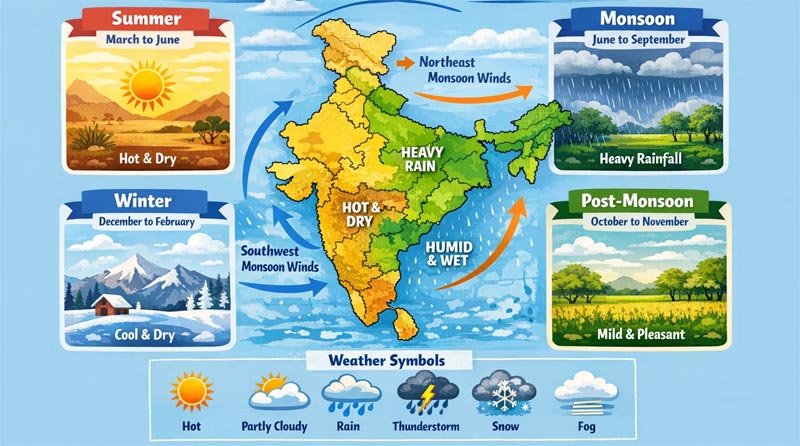
Below are the major topics that are important for the social studies chapter 2 of NCERT class 7:
- What is weather? – the atmosphere, the troposphere, and the elements of weather
- Temperature – how thermometers work and how to calculate daily temperature range
- Precipitation – how rainfall is measured using a rain gauge
- Atmospheric Pressure – what it is, how it varies, and how a barometer measures it
- Wind – speed and direction, measured using wind vanes and anemometers
- Humidity – water vapour in the air, measured using a hygrometer
- Weather Stations – how all instruments come together, including Automated Weather Stations
- Predicting the Weather – how meteorologists use data to forecast extreme weather events
This chapter also connects weather science to real life. It discusses how weather forecast help fishermen, farmers, pilots, and disaster management teams. Understanding weather is more important than ever today, with climate change making extreme events like cyclones, droughts, and heatwaves more frequent.
To test your understanding of this chapter, we have put together a set of MCQ questions for Class 7 Social Science covering all the key topics.
Class 7 Understanding the Weather MCQ Questions with Answers
Class 7 SST Chapter 2 Understanding the Weather MCQ Questions
1. Weather is best defined as
a) the average climate of a place over many years
b) the state of the Earth’s atmosphere at a particular time and place
c) only the temperature of a region
d) the amount of rainfall in one season
Answer:
b) the state of the Earth’s atmosphere at a particular time and place
2. Most weather phenomena that affect life on Earth occur in the
a) stratosphere
b) ozone layer
c) troposphere
d) ionosphere
Answer:
c) troposphere
3. Which of the following is not one of the main elements of weather discussed in the chapter?
a) Humidity
b) Wind
c) Atmospheric pressure
d) Soil fertility
Answer:
d) Soil fertility
4. Which weather element refers to any form of water falling from the sky, including rain, snow, sleet, or hail?
a) Humidity
b) Precipitation
c) Pressure
d) Temperature
Answer:
b) Precipitation
5. Why is a common standard of measurement necessary in weather studies?
a) Because people in all places feel weather in exactly the same way
b) Because personal feelings about hot and cold can differ from one person to another
c) Because weather never changes from place to place
d) Because traditional knowledge is always inaccurate
Answer:
b) Because personal feelings about hot and cold can differ from one person to another
6. Which of the following traditional signs was mentioned in the chapter as a clue for possible rain or weather change?
a) Birds flying low
b) Rocks becoming lighter
c) Rivers suddenly drying up
d) Trees bending permanently
Answer:
a) Birds flying low
7. A thermometer that records the highest and lowest temperatures of the day helps us calculate the
a) wind chill factor only
b) range of temperature
c) annual rainfall
d) relative humidity
Answer:
b) range of temperature
8. If a place records 30 mm of rainfall in a day, it means
a) the rain fell for 30 minutes
b) the air pressure dropped by 30 units
c) the collected rainwater reached a height of 30 mm in the gauge
d) the river level rose by 30 metres
Answer:
c) the collected rainwater reached a height of 30 mm in the gauge
9. Atmospheric pressure generally becomes lower when we move
a) from mountains to the seacoast
b) from plains to higher altitudes
c) from winter to summer
d) from desert to forest
Answer:
b) from plains to higher altitudes
10. A pressure below 1000 millibars usually indicates
a) a heat wave
b) a depression or low-pressure system
c) perfect weather stability
d) very low humidity only
Answer:
b) a depression or low-pressure system
11. Wind moves mainly from
a) low-pressure areas to high-pressure areas
b) sea to land only
c) high-pressure areas to low-pressure areas
d) hot areas to cold areas only
Answer:
c) high-pressure areas to low-pressure areas
12. Which instrument is commonly used to measure wind speed?
a) Barometer
b) Hygrometer
c) Anemometer
d) Rain gauge
Answer:
c) Anemometer
13. Relative humidity of 100% means that the air is
a) completely free of water vapour
b) saturated with water vapour
c) too cold to hold any gases
d) under very high pressure
Answer:
b) saturated with water vapour
14. Which of the following is a correct use of humidity measurements mentioned in the chapter?
a) Measuring the depth of oceans
b) Preserving exhibits in museums
c) Calculating mountain height
d) Studying earthquakes
Answer:
b) Preserving exhibits in museums
15. Why are weather predictions especially important today according to the chapter?
a) Because seasons have completely disappeared
b) Because climate change is making extreme weather events more frequent
c) Because weather can now be controlled by machines
d) Because only farmers need weather information
Answer:
b) Because climate change is making extreme weather events more frequent
Understanding the Weather Class 7 Assertion-Reason Questions
1. Assertion (A): Weather is measured using common standards. Reason (R): People may experience the same temperature differently, so exact comparison needs standard measurement.
a) Both A and R are true, and R is the correct explanation of A
b) Both A and R are true, but R is not the correct explanation of A
c) A is true, but R is false
d) A is false, but R is true
Answer:
a) Both A and R are true, and R is the correct explanation of A
2. Assertion (A): A rain gauge is used to measure rainfall. Reason (R): It collects rainwater and measures the depth of water collected.
a) Both A and R are true, and R is the correct explanation of A
b) Both A and R are true, but R is not the correct explanation of A
c) A is true, but R is false
d) A is false, but R is true
Answer:
a) Both A and R are true, and R is the correct explanation of A
3. Assertion (A): People may feel breathless at high altitudes. Reason (R): Atmospheric pressure and available oxygen are lower at higher altitudes.
a) Both A and R are true, and R is the correct explanation of A
b) Both A and R are true, but R is not the correct explanation of A
c) A is true, but R is false
d) A is false, but R is true
Answer:
a) Both A and R are true, and R is the correct explanation of A
4. Assertion (A): Wind direction and speed are useful in weather forecasting. Reason (R): Wind affects flying, sailing, rain prediction, and drying of soil.
a) Both A and R are true, and R is the correct explanation of A
b) Both A and R are true, but R is not the correct explanation of A
c) A is true, but R is false
d) A is false, but R is true
Answer:
a) Both A and R are true, and R is the correct explanation of A
5. Assertion (A): Accurate weather predictions help reduce the impact of disasters. Reason (R): Governments and people can prepare in advance for storms, cyclones, floods, or droughts.
a) Both A and R are true, and R is the correct explanation of A
b) Both A and R are true, but R is not the correct explanation of A
c) A is true, but R is false
d) A is false, but R is true
Answer:
a) Both A and R are true, and R is the correct explanation of A
Understanding the Weather Class 7 Fill in the blanks Questions
1. Weather is the state of the Earth’s __________ at a particular time and place.
Answer:
atmosphere
2. The layer of the atmosphere where almost all weather phenomena occur is the __________.
Answer:
troposphere
3. The amount of water vapour present in the air is called __________.
Answer:
humidity
4. The instrument used to measure rainfall is called a __________ gauge.
Answer:
rain
5. Atmospheric pressure is generally measured in __________.
Answer:
millibars
6. The instrument used to measure atmospheric pressure is called a __________.
Answer:
barometer
7. Wind moves from areas of high pressure to areas of __________ pressure.
Answer:
low
8. The instrument used to measure humidity is called a __________.
Answer:
hygrometer
9. An Automated Weather Station works without human __________.
Answer:
intervention
10. The India Meteorological Department was set up in the year __________.
Answer:
1875
Understanding the Weather Class 7 True or False Questions
1. Climate and weather mean exactly the same thing.
Answer:
False
2. The troposphere is thicker in the tropical zone than at the poles.
Answer:
True
3. Hail refers to small, hard balls of ice that fall from the sky.
Answer:
True
4. A thermometer is used to measure humidity.
Answer:
False
5. The normal atmospheric pressure at the sea coast is around 1013 millibars.
Answer:
True
6. Lower atmospheric pressure at high altitude makes breathing easier.
Answer:
False
7. A wind vane helps indicate wind direction.
Answer:
True
8. Dry weather usually has a relative humidity between 60% and 80%.
Answer:
False
9. Weather stations combine several instruments to measure and track weather.
Answer:
True
10. Accurate weather forecasts can help warn fishermen before stormy sea conditions.
Answer:
True
Understanding the Weather Class 7 Match the following Questions
Question 1
| Column A | Column B |
|---|---|
| 1. Thermometer | A. Humidity |
| 2. Rain gauge | B. Temperature |
| 3. Barometer | C. Wind speed |
| 4. Anemometer | D. Precipitation |
| 5. Hygrometer | E. Atmospheric pressure |
Answer:
| Column A | Correct Answer |
|---|---|
| 1. Thermometer | B. Temperature |
| 2. Rain gauge | D. Precipitation |
| 3. Barometer | E. Atmospheric pressure |
| 4. Anemometer | C. Wind speed |
| 5. Hygrometer | A. Humidity |
Question 2
| Column A | Column B |
|---|---|
| 1. Troposphere | A. Self-operating weather system |
| 2. Wind sock | B. Layer where weather occurs |
| 3. AWS | C. Warning to pilots about wind direction |
| 4. Depression | D. Low-pressure system |
| 5. Meteorology | E. Systematic study of weather |
Answer:
| Column A | Correct Answer |
|---|---|
| 1. Troposphere | B. Layer where weather occurs |
| 2. Wind sock | C. Warning to pilots about wind direction |
| 3. AWS | A. Self-operating weather system |
| 4. Depression | D. Low-pressure system |
| 5. Meteorology | E. Systematic study of weather |
Related Class 7 Social Science Chapters
Continue with the other geography chapters on India’s land and people:
- Geographical Diversity of India MCQs
- Climates of India MCQs
- The Story of Indian Farming MCQs
- India and Her Neighbours MCQs
Next chapter: Chapter 3 – Climates of India
See all chapters: Class 7 Social Science MCQ – All Chapters
