
NCERT Solutions for Class 8 Maths Exercise 4.2 Chapter 4 Data Handling
1. List the outcomes you can see in these experiments.
(a) Spinning a wheel (b) Tossing two coins together
1. List the outcomes you can see in these experiments.
(a) Spinning a wheel
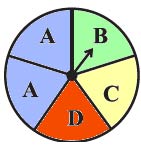
Step 1: Identify the distinct regions on the wheel.
The wheel is divided into 4 sections, labeled A, B, C, and D.
Step 2: List each section as a possible outcome.
– Landing on section A
– Landing on section B
– Landing on section C
– Landing on section D
Step 3: Consider the frequency of each label.
Sections labeled A appear twice, so ‘Landing on section A’ is an outcome that has two chances to occur.
Outcome List:
– A (twice, since there are two sections labeled A)
– B
– C
– D
Final Note: Each labeled section represents a separate outcome when the wheel is spun.
When tossing two coins together, the possible outcomes are:
– Both coins show heads (HH)
– The first coin shows heads and the second coin shows tails (HT)
– The first coin shows tails and the second coin shows heads (TH)
– Both coins show tails (TT)
Explanation:
– Each coin has two possible outcomes when tossed: heads (H) or tails (T).
– When two coins are tossed, each coin’s outcome is independent of the other.
– The total number of outcomes is found by multiplying the number of outcomes for each individual coin (2 for the first coin times 2 for the second coin), which equals 4 possible outcomes.
2. When a die is thrown, list the outcomes of an event of getting
(i) (a) a prime number (b) not a prime number.
(ii) (a) a number greater than 5 (b) a number not greater than 5.
(i) (a) a prime number
(a) a prime number are:
– 2
– 3
– 5
Explanation:
– Prime numbers are numbers that have exactly two distinct positive divisors: 1 and the number itself.
– On a die, the prime numbers are 2, 3, and 5.
(i) (b) not a prime number are:
– 1
– 4
– 6
Explanation:
– Non-prime numbers (also called composite numbers, except for 1 which is neither prime nor composite) are numbers that have more than two divisors.
– On a die, the non-prime numbers are 1, 4, and 6, as 1 is not considered prime and both 4 and 6 have divisors other than 1 and themselves.
(ii) (a) a number greater than 5 are:
– 6
Explanation:
– The only number greater than 5 on a die is 6.
(ii) (b) a number not greater than 5 are:
– 1
– 2
– 3
– 4
– 5
Explanation:
– These are all the numbers on a die that are 5 or less.
3. Find the.
(a) Probability of the pointer stopping on D in (Question 1-(a))?
(b) Probability of getting an ace from a well shuffled deck of 52 playing cards?
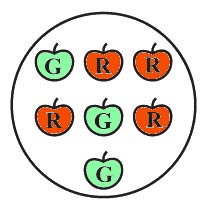
(c) Probability of getting a red apple. (See figure below)
(a) Probability of the pointer stopping on D in (Question 1-(a)):
– There is 1 section marked with D.
– There are a total of 8 sections.
Probability = Number of favorable outcomes / Total number of outcomes
= 1 / 8
Explanation:
– The probability is calculated by dividing the number of sections with D by the total number of sections.
(b) Probability of getting an ace from a well shuffled deck of 52 playing cards:
– There are 4 aces in a deck of cards.
– There are a total of 52 cards in the deck.
Probability = Number of aces / Total number of cards
= 4 / 52
= 1 / 13
Explanation:
– The probability is calculated by dividing the number of aces by the total number of cards.
(c) Probability of getting a red apple:
– There are 3 red apples.
– There are a total of 7 apples.
Probability = Number of red apples / Total number of apples
= 3 / 7
Explanation:
– The probability is calculated by dividing the number of red apples by the total number of apples.
4. Numbers 1 to 10 are written on ten separate slips (one number on one slip), kept in a box and mixed well. One slip is chosen from the box without looking into it. What is the probability of –
(i) getting a number 6?
(ii) getting a number less than 6?
(iii) getting a number greater than 6?
(iv) getting a 1-digit number?
(i) The probability of getting a number 6:
– There is 1 slip with the number 6.
– There are a total of 10 slips.
Probability = Number of slips with number 6 / Total number of slips
= 1 / 10
Explanation:
– Since there is only one slip with the number 6, the probability is the number of slips with 6 divided by the total number of slips.
(ii) The probability of getting a number less than 6:
– The numbers less than 6 are 1, 2, 3, 4, and 5.
– There are 5 slips with numbers less than 6.
Probability = Number of slips with numbers less than 6 / Total number of slips
= 5 / 10
= 1 / 2
Explanation:
– There are five slips with numbers less than 6, so the probability is the number of such slips divided by the total number of slips.
(iii) The probability of getting a number greater than 6:
– The numbers greater than 6 are 7, 8, 9, and 10.
– There are 4 slips with numbers greater than 6.
Probability = Number of slips with numbers greater than 6 / Total number of slips
= 4 / 10
= 2 / 5
Explanation:
– There are four slips with numbers greater than 6, so the probability is the number of such slips divided by the total number of slips.
(iv) The probability of getting a 1-digit number:
– The 1-digit numbers are 1, 2, 3, 4, 5, 6, 7, 8, and 9.
– There are 9 slips with 1-digit numbers.
Probability = Number of slips with 1-digit numbers / Total number of slips
= 9 / 10
Explanation:
– Since there are nine 1-digit numbers, the probability is the number of 1-digit number slips divided by the total number of slips.
5. If you have a spinning wheel with 3 green sectors, 1 blue sector and 1 red sector, what is the probability of getting a green sector? What is the probability of getting a non blue sector?
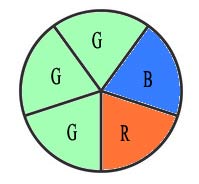
The probability of getting a green sector:
– There are 3 green sectors.
– There are a total of 5 sectors (3 green, 1 blue, 1 red).
Probability = Number of green sectors / Total number of sectors
= 3 / 5
Explanation:
– The probability is calculated by dividing the number of green sectors by the total number of sectors on the wheel.
The probability of getting a non blue sector:
– There are 4 non blue sectors (3 green and 1 red).
– There are a total of 5 sectors.
Probability = Number of non blue sectors / Total number of sectors
= 4 / 5
Explanation:
– To find the probability of not getting a blue sector, we count all the sectors that are not blue and divide by the total number of sectors.
6. Find the probabilities of the events given below
(i) When a die is thrown, the outcomes of getting:
(a) a prime number are:
– 2
– 3
– 5
Probability = Number of prime numbers / Total number of outcomes
= 3 / 6
= 1 / 2
Explanation:
– The prime numbers on a die are 2, 3, and 5. There are three prime numbers out of six possible outcomes on a die.
(b) not a prime number are:
– 1
– 4
– 6
Probability = Number of non-prime numbers / Total number of outcomes
= 3 / 6
= 1 / 2
Explanation:
– The numbers that are not prime on a die are 1, 4, and 6. There are three outcomes that are not prime out of six possible outcomes on a die.
(ii) When a die is thrown, the outcomes of getting:
(a) a number greater than 5 are:
– 6
Probability = Number of outcomes greater than 5 / Total number of outcomes
= 1 / 6
Explanation:
– The only number greater than 5 on a die is 6. There is one outcome out of six possible outcomes on a die.
(b) a number not greater than 5 are:
– 1
– 2
– 3
– 4
– 5
Probability = Number of outcomes not greater than 5 / Total number of outcomes
= 5 / 6
Explanation:
– The numbers on a die that are not greater than 5 are 1, 2, 3, 4, and 5. There are five such outcomes out of six possible outcomes on a die.
