
Why does it snow in Ladakh while Kerala receives heavy rain at the same time of year? Why is Rajasthan a desert and on the other hand, Meghalaya is one of the wettest places on Earth? The answer lies in India’s remarkably diverse climate.
In Chapter 3 of the Class 7 Social Science textbook Exploring Society: India and Beyond, we are going to learn more about Climates of India. It is part of the India and the World: Land and the People unit. In this chapter, we are going to go deep into what shapes India’s climate, how the monsoon works, and how the climate affects everyday life.
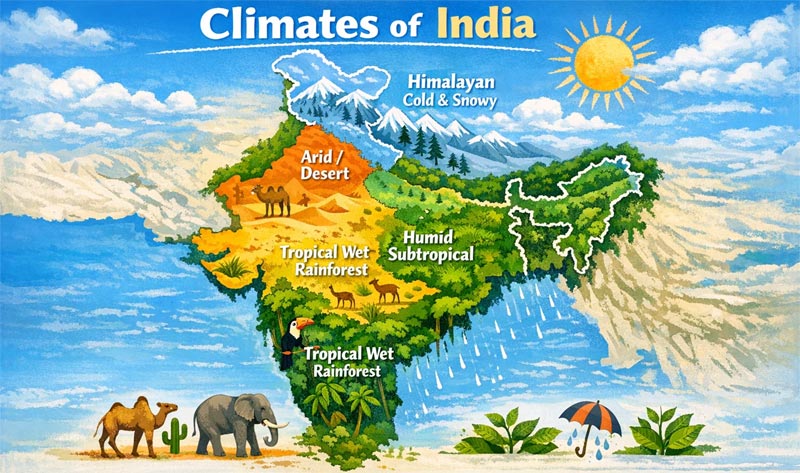
Here is a quick look at what this chapter covers:
- Weather, Seasons and Climate – the difference between the three, and India’s six traditional seasons
- Types of Climates in India – alpine, temperate, subtropical, arid, tropical wet, semi-arid, and tropical
- Factors Determining the Climate – latitude, altitude, proximity to the sea, winds, and topography
- The Monsoons – how they form, the southwest and northeast monsoons, and their importance
- Climate and our Lives – impact on festivals, agriculture, and the economy
- Climates and Disasters – cyclones, floods, landslides, and forest fires
- Climate Change – causes, consequences, and what is being done about it
This chapter is very important in today’s times of global warming and whatnot. Climate change is causing extreme weather events. It is important to understand how the climate works and it is no longer just a school topic. It affects farmers, fishermen, city dwellers, and governments across India every year.
To test your understanding of this chapter, we have put together a set of MCQ questions for Class 7 Social Science covering all the key topics.
Class 7 Climates of India MCQ Questions with Answers
Class 7 SST Chapter 3 Climates of India MCQ Questions
1. Which of the following best describes climate?
a) The condition of the atmosphere at a particular hour
b) The pattern of weather in a region over a long period
c) The amount of rainfall received in one week
d) The direction of wind on a single day
Answer:
b) The pattern of weather in a region over a long period
2. Weather differs from climate because weather
a) remains the same for decades
b) is always hotter than climate
c) changes from hour to hour or day to day
d) is not related to seasons
Answer:
c) changes from hour to hour or day to day
3. Traditionally, in many parts of India, the year is divided into how many ṛitus or seasons?
a) Four
b) Five
c) Six
d) Seven
Answer:
c) Six
4. Which of the following is the correct traditional order of Indian seasons mentioned in the chapter?
a) Summer, winter, spring, monsoon, autumn, pre-winter
b) Vasanta, grīṣhma, varṣhā, śharad, hemanta, śhiśhir
c) Monsoon, spring, autumn, winter, summer, pre-winter
d) Vasanta, varṣhā, śharad, grīṣhma, hemanta, śhiśhir
Answer:
b) Vasanta, grīṣhma, varṣhā, śharad, hemanta, śhiśhir
5. Which type of climate is found in the higher Himalayan mountains?
a) Arid climate
b) Alpine climate
c) Tropical wet climate
d) Semi-arid climate
Answer:
b) Alpine climate
6. Many hill stations in India are located in regions with a ______ climate.
a) temperate
b) arid
c) equatorial
d) polar
Answer:
a) temperate
7. The climate of the northern plains is described in the chapter as
a) tropical wet
b) alpine
c) subtropical
d) tundra
Answer:
c) subtropical
8. Which region of India has an arid climate with extremely hot days, cool nights, and very little rainfall?
a) Western coastal strip
b) Thar Desert
c) Meghalaya Plateau
d) Ganga Plain
Answer:
b) Thar Desert
9. The western coastal strip mainly has a
a) tropical wet climate
b) frigid climate
c) semi-arid climate
d) alpine climate
Answer:
a) tropical wet climate
10. The central Deccan Plateau has a climate best described as
a) tropical wet
b) semi-arid
c) alpine
d) polar
Answer:
b) semi-arid
11. Places near the Equator are generally warmer because
a) they are farther from the Sun
b) the Sun’s rays fall more directly on them
c) they have less atmosphere
d) they are always at sea level
Answer:
b) the Sun’s rays fall more directly on them
12. Which pair is correctly used in the chapter to show the effect of latitude on climate in India?
a) Mumbai and Nagpur
b) Ooty and Coimbatore
c) Kanniyakumari and Srinagar
d) Jaipur and Leh
Answer:
c) Kanniyakumari and Srinagar
13. Hill stations are cooler than nearby plains mainly because
a) they are closer to the sea
b) temperature decreases with altitude
c) they receive no sunlight
d) they have more buildings
Answer:
b) temperature decreases with altitude
14. Mumbai has a smaller range of temperature than Nagpur mainly because Mumbai
a) lies in a desert region
b) is at a higher altitude
c) is near the sea
d) receives no monsoon rain
Answer:
c) is near the sea
15. Dry and hot summer winds affecting states such as Punjab, Haryana, Rajasthan, and Madhya Pradesh come mainly from
a) the Bay of Bengal
b) the Himalayas
c) the west through desert regions
d) the Indian Ocean in winter
Answer:
c) the west through desert regions
16. A microclimate is best understood as
a) the climate of a whole country
b) the weather of one particular day
c) the climate of a small area that differs from the surrounding region
d) a climate found only on mountains
Answer:
c) the climate of a small area that differs from the surrounding region
17. The word “monsoon” comes from the Arabic word mausim, meaning
a) rain
b) cloud
c) wind
d) season
Answer:
d) season
18. During the summer monsoon, winds generally blow
a) from land to sea
b) from the cooler ocean towards the hotter land
c) from north to south only
d) from mountains to plains only
Answer:
b) from the cooler ocean towards the hotter land
19. Which statement about the winter or northeast monsoon is correct?
a) It always brings heavy rain to all of India
b) It blows from ocean to land
c) Part of it brings rainfall to parts of east and south India after crossing the Bay of Bengal
d) It is another name for the southwest monsoon
Answer:
c) Part of it brings rainfall to parts of east and south India after crossing the Bay of Bengal
20. Which of the following is a major human cause of recent climate change according to the chapter?
a) The Earth’s revolution
b) Natural change in seasons
c) Burning of fossil fuels and deforestation
d) Formation of hill stations
Answer:
c) Burning of fossil fuels and deforestation
Climates of India Class 7 Assertion-Reason Questions
1. Assertion (A): Climate is different from weather. Reason (R): Weather refers to day-to-day atmospheric conditions, while climate refers to long-term patterns over decades.
a) Both A and R are true, and R is the correct explanation of A
b) Both A and R are true, but R is not the correct explanation of A
c) A is true, but R is false
d) A is false, but R is true
Answer:
a) Both A and R are true, and R is the correct explanation of A
2. Assertion (A): Ooty is much cooler than Coimbatore even though both are at almost the same latitude. Reason (R): Ooty is situated at a higher altitude, and temperature decreases with altitude.
a) Both A and R are true, and R is the correct explanation of A
b) Both A and R are true, but R is not the correct explanation of A
c) A is true, but R is false
d) A is false, but R is true
Answer:
a) Both A and R are true, and R is the correct explanation of A
3. Assertion (A): Coastal cities usually have a smaller range of temperature than inland cities. Reason (R): The sea acts as a moderator and heats and cools more slowly than land.
a) Both A and R are true, and R is the correct explanation of A
b) Both A and R are true, but R is not the correct explanation of A
c) A is true, but R is false
d) A is false, but R is true
Answer:
a) Both A and R are true, and R is the correct explanation of A
4. Assertion (A): The western slopes of the Western Ghats receive more rainfall than the Deccan Plateau to the east. Reason (R): The Western Ghats act as a natural barrier to the advancing monsoon winds.
a) Both A and R are true, and R is the correct explanation of A
b) Both A and R are true, but R is not the correct explanation of A
c) A is true, but R is false
d) A is false, but R is true
Answer:
a) Both A and R are true, and R is the correct explanation of A
5. Assertion (A): Human activities are now a major cause of climate change. Reason (R): Burning fossil fuels and deforestation increase greenhouse gases and trap extra heat in the atmosphere.
a) Both A and R are true, and R is the correct explanation of A
b) Both A and R are true, but R is not the correct explanation of A
c) A is true, but R is false
d) A is false, but R is true
Answer:
a) Both A and R are true, and R is the correct explanation of A
Climates of India Class 7 Fill in the blanks Questions
1. Weather is what we experience from day to day, while climate is the long-term __________ of weather in a region.
Answer:
pattern
2. In many parts of India, the traditional rainy season is called __________.
Answer:
varṣhā
3. The climate in the higher Himalayas is called __________ climate.
Answer:
alpine
4. The climate of the northern plains is generally __________, with hot summers and cold winters.
Answer:
subtropical
5. Places close to the Equator receive the Sun’s rays more __________ than polar regions.
Answer:
directly
6. As altitude increases, temperature generally __________.
Answer:
decreases
7. The sea acts as a __________ for temperature in coastal areas.
Answer:
moderator
8. The summer monsoon is also called the __________ monsoon.
Answer:
southwest
9. The cloudless centre of a cyclone is called its __________.
Answer:
eye
10. Governments promote climate __________ by reducing greenhouse gas emissions and planting trees.
Answer:
mitigation
Climates of India Class 7 True or False Questions
1. Weather remains almost unchanged over several decades.
Answer:
False
2. India has a rainy season or monsoon in addition to the four main seasons found in many regions of the world.
Answer:
True
3. The Thar Desert has a tropical wet climate.
Answer:
False
4. Places near the poles receive the Sun’s rays at a more oblique angle than places near the Equator.
Answer:
True
5. Mumbai and Nagpur are used in the chapter to show the effect of proximity to the sea on climate.
Answer:
True
6. Winds coming from the sea are usually drier than winds coming from deserts.
Answer:
False
7. Urban heat islands are usually cooler than the surrounding rural areas.
Answer:
False
8. The southwest monsoon usually begins from the southern tip of India in early June.
Answer:
True
9. Mawsynram in Meghalaya receives one of the lowest average annual rainfalls in the world.
Answer:
False
10. Climate-related disasters can disturb agriculture, damage infrastructure, and affect local economies.
Answer:
True
Climates of India Class 7 Match the following Questions
Question 1
| Column A | Column B |
|---|---|
| 1. Alpine climate | A. Found in the Thar Desert |
| 2. Arid climate | B. Higher Himalayas |
| 3. Tropical wet climate | C. Western coastal strip |
| 4. Semi-arid climate | D. Central Deccan Plateau |
| 5. Subtropical climate | E. Northern plains |
Answer:
| Column A | Correct Answer |
|---|---|
| 1. Alpine climate | B. Higher Himalayas |
| 2. Arid climate | A. Found in the Thar Desert |
| 3. Tropical wet climate | C. Western coastal strip |
| 4. Semi-arid climate | D. Central Deccan Plateau |
| 5. Subtropical climate | E. Northern plains |
Question 2
| Column A | Column B |
|---|---|
| 1. Latitude | A. Affected by nearby water body |
| 2. Altitude | B. Difference due to angle of Sun’s rays |
| 3. Proximity to the sea | C. Temperature decreases with height |
| 4. Southwest monsoon | D. Winds from ocean to land in summer |
| 5. Eye of a cyclone | E. Cloudless centre |
Answer:
| Column A | Correct Answer |
|---|---|
| 1. Latitude | B. Difference due to angle of Sun’s rays |
| 2. Altitude | C. Temperature decreases with height |
| 3. Proximity to the sea | A. Affected by nearby water body |
| 4. Southwest monsoon | D. Winds from ocean to land in summer |
| 5. Eye of a cyclone | E. Cloudless centre |
Related Class 7 Social Science Chapters
Continue with the other geography chapters on India’s land and people:
- Geographical Diversity of India MCQs
- Understanding the Weather MCQs
- The Story of Indian Farming MCQs
- India and Her Neighbours MCQs
Next chapter: Chapter 4 – New Beginnings: Cities and States
See all chapters: Class 7 Social Science MCQ – All Chapters
